- There is no single best cybersecurity framework. The right choice depends on your statutory, regulatory and contractual obligations, plus what your customers expect.
- The top 10 frameworks fall into six types: voluntary frameworks, certifiable standards, control catalogs, attestations, contractual and regulatory requirements, and governance and data protection frameworks.
- The Secure Controls Framework (SCF) is a free metaframework that maps 1,500+ controls to 200+ laws, regulations and frameworks, and it is certifiable through the SCR Conformity Assessment Program (SCR CAP).
- Certification differs by framework. ISO/IEC 27001 and the SCF offer organizational certification, SOC 2 is a CPA attestation report, and NIST CSF and the CIS Controls have no official certification.
- Cybersecurity negligence is not following industry-recognized practices or failing to meet all compliance requirements. Most insurance policies have a negligence loophole that precludes paying out for it.
- The solution is to align with a recognized cybersecurity framework and document your policies, standards and procedures as evidence of due care and due diligence.
What Are The Top 10 Cybersecurity & Data Protection Frameworks?
The top 10 cybersecurity and data protection frameworks are listed below with their type and how conformity is validated. The type matters because it determines how you prove compliance: self-assessment, independent certification, a CPA attestation report or a contractual assessment.
The list is grouped by framework type, so the numbering reflects the grouping, not a ranking of which framework is best for your organization. Most organizations use more than one. For example, NIST CSF 2.0 for leadership reporting, a detailed control set such as the SCF or NIST SP 800-53 for day-to-day operations, and SOC 2 or ISO/IEC 27001 for customer assurance.
ComplianceForge is an authorized SCF Licensed Content Provider (LCP) and sells cybersecurity documentation for the SCF and for several other frameworks on this list. The pros and cons below are based on each framework's published scope and how it is assessed.
Which Voluntary Cybersecurity Frameworks Are Most Widely Used?
Voluntary frameworks are free to adopt and are not required by law on their own. You use them to structure and report on a cybersecurity program, and you show alignment through self-assessment.
1. NIST Cybersecurity Framework (CSF) 2.0
Published by NIST on February 26, 2024, CSF 2.0 organizes cybersecurity outcomes into six Functions: Govern, Identify, Protect, Detect, Respond and Recover. It describes the outcomes to achieve, not how to achieve them.
Best for: Organizations of any size or sector that need a common language for cybersecurity risk with executives and the board.
- Free to use and widely recognized by executives, insurers and regulators
- The Govern Function added in 2.0 ties cybersecurity to enterprise risk management
- Outcome-based, so it scales from small businesses to large enterprises
- Informative References map CSF outcomes to other frameworks, such as NIST SP 800-53
- High-level outcomes, not prescriptive controls, so you still need a detailed control set
- NIST does not certify organizations against the CSF
- Profiles and Tiers take effort to apply consistently across the organization
ComplianceForge resources: NIST CSF 2.0 Compliance Resource Center
2. CIS Critical Security Controls (CIS Controls) v8.1
The Center for Internet Security (CIS) publishes 18 prioritized Controls, each broken into specific Safeguards. Implementation Groups (IG1, IG2 and IG3) tell you which Safeguards to start with based on your resources and risk.
Best for: Small and mid-sized organizations that want a prioritized, technical starting point.
- Prioritized and prescriptive, so teams know where to start
- IG1 defines a practical baseline of essential cyber hygiene
- Free to download, with mappings to other frameworks
- Focused on technical safeguards, with lighter coverage of governance, privacy and third-party risk
- CIS does not certify organizations against the CIS Controls
- Usually needs to be paired with a broader framework to satisfy laws and contracts
ComplianceForge resources: CIS Controls Compliance Resource Center
Which Cybersecurity Frameworks Can You Get Certified Against?
Certifiable standards let an independent assessor confirm your conformity, which gives customers, partners and insurers third-party assurance instead of a self-attestation.
3. ISO/IEC 27001 & ISO/IEC 27002
ISO/IEC 27001:2022 specifies the requirements for an Information Security Management System (ISMS). Its Annex A lists 93 controls in four themes: organizational, people, physical and technological. ISO/IEC 27002:2022 provides implementation guidance for those controls.
Best for: Organizations that sell internationally or need a globally recognized security certification.
- Internationally recognized certification issued by accredited certification bodies
- The management system approach builds continuous improvement into the program
- Risk-based, so controls are selected through your risk assessment and Statement of Applicability (SoA)
- The standards must be purchased, and certification and surveillance audits add recurring cost
- Annex A controls are high-level, so you still need detailed policies, standards and procedures
- Certification scope can be narrow, so a certificate may not cover every part of the business
ComplianceForge resources: ISO 27001 & 27002 Compliance Resource Center
4. Secure Controls Framework (SCF)
The SCF is a free metaframework with 1,500+ controls across 34 domains that are mapped to 200+ laws, regulations and frameworks. Organizations can be certified through the Secure, Compliant & Resilient Conformity Assessment Program (SCR CAP), where accredited SCR Third-Party Assessment Organizations (3PAOs) perform the assessments and The Cyber AB serves as the Accreditation Body. Certifications can target specific laws, regulations and frameworks, such as NIST CSF 2.0 or NIST SP 800-171 R3.
Best for: Organizations with multiple compliance obligations that want one control set to demonstrate conformity with all of them.
- One set of controls covers many obligations, which reduces duplicate work, evidence and audits
- Free to use under a Creative Commons license
- Mappings use Set Theory Relationship Mapping (STRM), the methodology described in NIST IR 8477
- Certifiable through the SCR CAP, so the SCF can be both your control set and your certification target
- Covers privacy, AI, supply chain and resilience in the same catalog as security
- 1,500+ controls is a lot, so scoping and tailoring are required up front
- The SCR CAP is newer than ISO 27001 certification or SOC 2, so some customers and auditors are less familiar with it
- Most laws and contracts do not name the SCF, so you demonstrate conformity through its mappings
Disclosure: ComplianceForge is an authorized SCF Licensed Content Provider (LCP).
ComplianceForge resources: Secure Controls Framework (SCF) Compliance Resource Center
When Should You Use NIST SP 800-53 As Your Control Catalog?
A control catalog provides detailed, prescriptive controls that you select and tailor. NIST SP 800-53 is the most widely referenced control catalog for US federal systems.
5. NIST SP 800-53 Rev 5
NIST SP 800-53 Rev 5 is a catalog of security and privacy controls organized into 20 control families. NIST SP 800-53B defines low, moderate and high baselines, plus a privacy baseline. It is the control set used for federal information systems under FISMA and for FedRAMP cloud authorizations.
Best for: Federal agencies, federal contractors and cloud providers that sell to government, plus organizations that want a very detailed control catalog.
- Very comprehensive, with security and privacy controls in one catalog
- Free, with baselines that scale from low-impact to high-impact systems
- Widely used as a source for other frameworks and mappings
- Large and complex, especially once control enhancements are included
- Written for federal systems, so terminology and assumptions do not always fit commercial organizations
- No certification on its own; assessments happen through federal processes such as an Authority to Operate (ATO)
ComplianceForge resources: NIST SP 800-53 Rev 5 Compliance Resource Center
Is SOC 2 A Cybersecurity Framework Or A Report?
An attestation is a CPA firm's opinion on your controls. SOC 2 uses the AICPA Trust Services Criteria as its framework, and the result is a report you share with customers, usually under a nondisclosure agreement.
6. SOC 2 (AICPA Trust Services Criteria)
A SOC 2 report is an attestation by a licensed CPA firm on a service organization's controls, evaluated against the AICPA Trust Services Criteria (TSC) for Security, Availability, Processing Integrity, Confidentiality and Privacy. Security is included in every SOC 2 report. A Type 1 report covers control design at a point in time, and a Type 2 report covers operating effectiveness over a period of time.
Best for: SaaS and other service providers whose US business customers ask for a SOC 2 report.
- Widely requested by US customers during vendor due diligence
- Flexible, since you choose which Trust Services Criteria categories are in scope
- A Type 2 report shows controls operated over time, not just on paper
- It is an attestation report, not a certification
- CPA firm fees, and most organizations renew the report every year
- The criteria are not prescriptive, so you still need to define your own controls
- Less recognized outside the US than ISO/IEC 27001
ComplianceForge resources: AICPA TSC (SOC 2) Compliance Resource Center
Which Cybersecurity Frameworks Are Required By Contracts Or Regulations?
These frameworks are not optional once they apply to you. Payment card agreements require PCI DSS, and DoD contracts require NIST SP 800-171 and CMMC for systems that handle CUI.
7. PCI DSS v4.0.1
The Payment Card Industry Data Security Standard (PCI DSS) is published by the PCI Security Standards Council and required by the payment card brands through merchant and service provider agreements. Version 4.0.1 was released in June 2024, and its future-dated requirements became effective March 31, 2025.
Best for: Any organization that stores, processes or transmits payment card data.
- Prescriptive requirements with clear testing procedures
- Validation scales from Self-Assessment Questionnaires (SAQs) to a Report on Compliance (ROC) by a Qualified Security Assessor (QSA)
- Reducing where cardholder data lives can reduce the compliance effort
- Only covers the cardholder data environment, not your whole security program
- Not optional if you accept cards, and non-compliance may lead to fines or loss of card acceptance
- Annual validation and recurring testing add ongoing work
ComplianceForge resources: PCI DSS Compliance Documentation
8. NIST SP 800-171 & CMMC
NIST SP 800-171 defines requirements to protect Controlled Unclassified Information (CUI) in nonfederal systems. The DoD Cybersecurity Maturity Model Certification (CMMC) program rule (32 CFR Part 170) became effective December 16, 2024, and the DFARS rule that phases CMMC into contracts became effective November 10, 2025. CMMC Level 2 is based on NIST SP 800-171 Rev 2, while Rev 3 is the current NIST version.
Best for: Defense contractors and subcontractors, and other federal contractors that handle CUI.
- Clear, assessable requirements with a published assessment methodology (NIST SP 800-171A)
- Required to win and keep DoD contracts that involve CUI, so compliance protects revenue
- The NIST publications are free to use
- Narrow purpose (protecting CUI), so it does not cover your other obligations
- The Rev 2 vs Rev 3 split between DoD contracts and the current NIST version adds planning complexity
- CMMC Level 2 certification assessments by a C3PAO add cost and lead time
ComplianceForge resources: NIST SP 800-171 Compliance Resource Center | CMMC 2.0 Compliance Resource Center
Which Frameworks Cover IT Governance And Data Privacy?
Security frameworks do not fully address board-level IT governance or privacy. COBIT 2019 covers governance, and privacy frameworks cover how personal data is collected, used, shared and protected.
9. COBIT 2019
COBIT 2019, published by ISACA, is a framework for the governance and management of enterprise information and technology. It defines 40 governance and management objectives and uses design factors to tailor a governance system to the organization.
Best for: Boards, auditors and IT leaders who need to align technology with business goals. It is often used in IT audit and SOX IT general controls work.
- Connects IT and security to business goals and board oversight
- Strong fit for internal and external IT audit
- Includes a capability-based approach to measuring process performance
- Not a security control catalog, so it needs to be paired with a security framework
- Abstract and documentation-heavy for smaller organizations
- No organizational certification (ISACA certifies individuals, not organizations)
10. ISO/IEC 27701
ISO/IEC 27701:2025 specifies requirements for a Privacy Information Management System (PIMS) and, in its 2025 edition, can be certified on its own rather than only as an extension of ISO/IEC 27001.
Best for: Organizations subject to privacy laws, such as GDPR or US state privacy laws, that want a structured privacy program.
- Gives privacy a program structure instead of a law-by-law checklist
- Can be augmented with NIST Privacy Framework to pair with NIST CSF
- ISO/IEC 27701 offers an internationally recognized privacy certification
- Neither framework replaces specific legal obligations, such as GDPR or CCPA requirements
- Expensive to purchase, based on per-seat licensing.
- ISO/IEC 27701 must be purchased and adds certification audit costs
ComplianceForge resources: Data Privacy Program (DPP) | Data Privacy Laws & Regulations
How Do I Choose The Right Cybersecurity Framework?
Start with what you are required to do, add what your customers expect, then choose a control set that covers both.
- List your statutory, regulatory and contractual obligations, such as HIPAA, PCI DSS, DFARS or state privacy laws.
- Identify the assurance your customers ask for, such as SOC 2 reports or ISO/IEC 27001 certificates.
- Choose one control set that maps to all of them, so you implement and evidence each control once.
- Document policies, standards and procedures as evidence of due care and due diligence.
What is the most popular cybersecurity framework?
NIST CSF is one of the most widely referenced cybersecurity frameworks, especially in the US, and ISO/IEC 27001 is one of the most widely recognized certifiable standards internationally. Popularity is not the same as fit, so choose based on your obligations and your customers' expectations.
Which cybersecurity frameworks are certifiable?
ISO/IEC 27001, ISO/IEC 27701 and the Secure Controls Framework (through the SCR CAP) offer organizational certification. CMMC uses third-party or government certification assessments at Level 2 and Level 3 when a contract requires them. SOC 2 is an attestation report, and NIST CSF, the CIS Controls, NIST SP 800-53 and COBIT do not offer organizational certification on their own.
What is the difference between a framework, a standard and a regulation?
A framework is a structure of outcomes or controls you can adopt, a standard defines specific requirements that can often be certified, and a law or regulation is a legal obligation. Contracts can make a voluntary framework mandatory, as DFARS does for NIST SP 800-171.
Can one framework cover multiple compliance requirements?
Yes. A metaframework such as the SCF maps its controls to 200+ laws, regulations and frameworks, so one set of controls and evidence can support several obligations. Mappings show coverage, but you still need to confirm each obligation's specific requirements.
Is NIST CSF the same as NIST SP 800-53?
No. NIST CSF 2.0 describes high-level cybersecurity outcomes, while NIST SP 800-53 is a detailed catalog of security and privacy controls. NIST SP 800-53 is one of the references you can use to achieve CSF outcomes.
How Does Framework Alignment Decrease Cybersecurity Liability?
Avoiding Professional Negligence Is Good For Business! The goal of IT security documentation is to build an IT security program for your company that decreases liabilities, while at the same time improving operational efficiencies, which equates to bottom-line savings for your company!

- If your company accepts credit cards, advises on financial matters, provides healthcare services, or maintains any sensitive Personally Identifiable Information (sPII) on clients or employees, then you are responsible for certain compliance requirements. These standards, dictated by the regulation or requirement, establish the objective benchmark for what “reasonably expected” IT security protections should be in place.
- If your company does not meet the minimum standards of a compliance requirement, that deficiency is evidence of negligence. Negligence can be as simple as outdated antivirus software, weak passwords, unencrypted wireless, unpatched operating systems, or inadequate IT security documentation. Ignorance is not an excuse!
- Negligence is demonstrated by a lack of documented due care and due diligence. If you are taken to court, a prosecuting attorney’s aim likely will be to prove negligence. Without documented due care and due diligence, the task is made easier to prove negligence and allow damages to be awarded to the plaintiff.
- The ramifications of being “negligent” can be devastating for a company, since most insurance policies have a “negligence loophole” built in that precludes insurers from having to pay out. The bottom line is your company may have to pay all fines, damages, and legal fees on its own, without any insurance reimbursement.
A single negligent event can cause a business to go out of business forever, since liability insurance may not cover professional negligence for IT security-related incidents. The simple rule of thumb is if you are not in compliance with what you are legally obligated to do, then you are professionally negligent.
How Do I Avoid Cybersecurity Negligence?
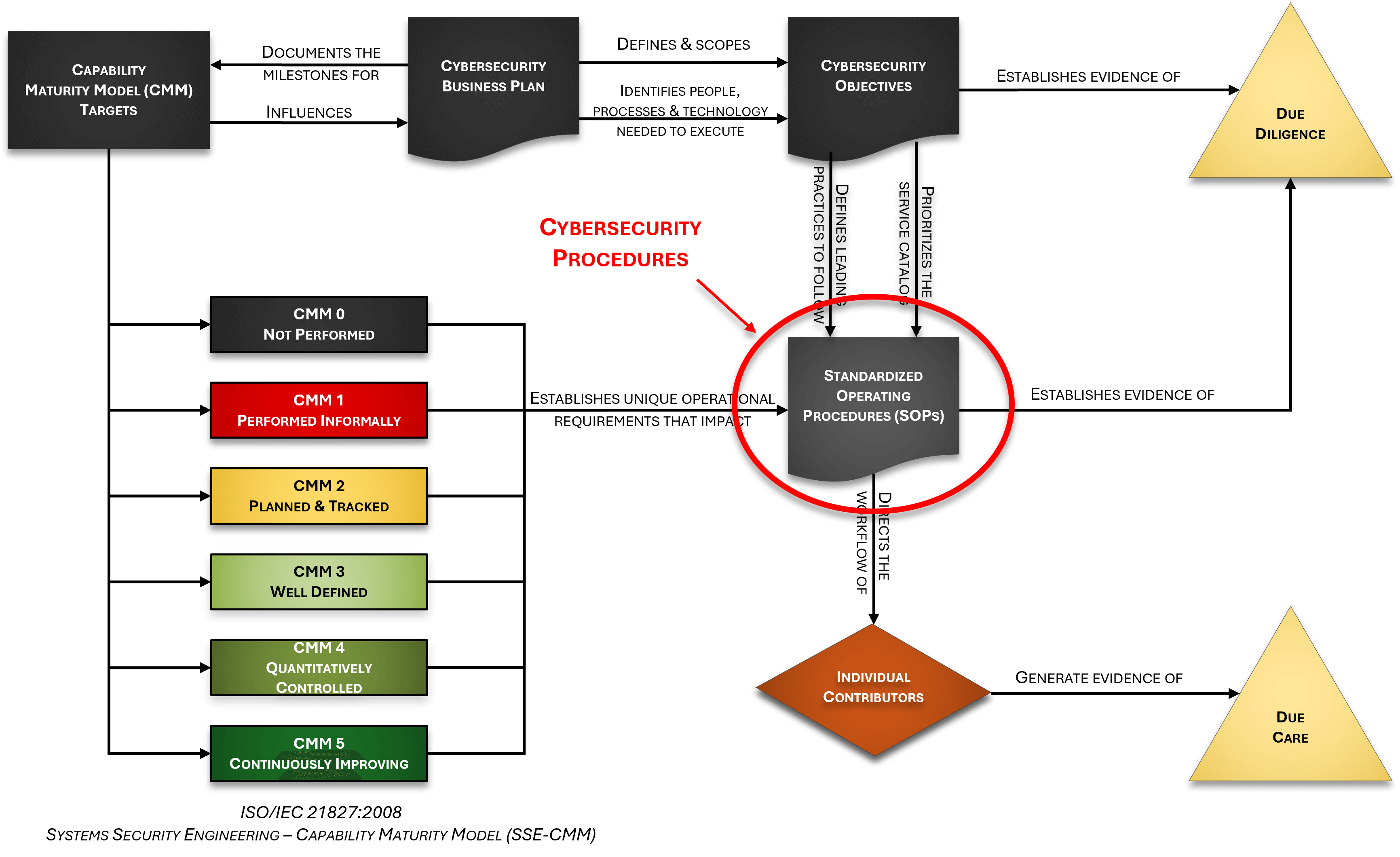
We leverage the Operationalizing Cybersecurity Planning Model in creating a practical view towards implementing cybersecurity requirements. Organizations are often not at a loss for a set of policies, but executing those requirements often fall short due to several reasons. Standardized Operating Procedures (SOPs) are where the rubber meets the road for Individual Contributors (ICs), since these key players need to know (1) how they fit into day-to-day operations, (2) what their priorities are and (3) what is expected from them in their duties. When looking at it from an auditability perspective, the evidence of due diligence and due care should match what the organization's cybersecurity business plan is attempting to achieve.
The central focus of any procedures should be a Capability Maturity Model (CMM) target that provides quantifiable expectations for People, Processes and Technologies (PPT), since this helps prevent a “moving target” by establishing an attainable expectation for “what right looks like” in terms of PPT. Generally, cybersecurity business plans take a phased, multi-year approach to meet these CMM-based cybersecurity objectives. Those objectives, in conjunction with the business plan, demonstrate evidence of due diligence on behalf of the CISO and his/her leadership team. The objectives prioritize the organization’s service catalog through influencing procedures at the IC-level for how PPT are implemented at the tactical level. SOPs not only direct the workflow of staff personnel, but the output from those procedures provides evidence of due care.
The diagram below helps show the critical nature of documented cybersecurity procedures in keeping an organization both secure and compliant:
Frequently-Asked Questions
Here are answers to the questions people ask most when choosing a cybersecurity framework: