
- Cybersecurity-focused risk management practices to implement a program-level governance function.
- Holistic approach to risk management aligns with NIST, ISO & SCF risk management practices.
- Leverages the Security, Compliance & Resilience Risk Management Model (SCR-RMM) from the SCF for scalability.
- Immense time & cost savings - enables subject matter experts to fill in the details that only they know.
Don't Write It From Scratch.
Nearly every framework and regulation expects you to manage cybersecurity risk in a documented, repeatable way. If an auditor or board member asked how your organization identifies, rates, treats, and tracks risk, could you show a defined process, or just a spreadsheet someone updates occasionally? Building a credible risk management program from a blank page takes specialized expertise most teams lack. The Risk Management Program (RMP) gives you a running start: an editable, program-level risk management playbook aligned to NIST, ISO, and the SCF's Risk Management Model (SCR-RMM), covering how risk is identified, assessed, treated, and reported. It gets you roughly 80 to 90 percent of the way there, then your team tailors the risk criteria and workflows to your organization.
The Cybersecurity Risk Management Program (RMP) is essentially a risk management playbook for how an organization addresses the broader concepts of risk management that are not provided by a policy or standard. It captures the details that explain how risk is actually managed, day to day, by the people who execute risk-based controls.
All companies have a need to manage risk. Most companies are compelled to manage risk and these requirements come from a broad range of sources. Regardless of your industry, there are likely requirements to manage cybersecurity risk and failing to manage risk could leave your company liable from non-compliance from these requirements:
Product Walkthrough Video
What Does This Product Walkthrough Cover?
To help explain the product in more detail, below is a product video that will give a walkthrough of our product. It will give a brief overview of what it is, what is included within the download, how the cost compares with writing it internally versus hiring a consultant, and how much customization remains when it arrives.
The walkthrough covers the same sections you will find further down this page, so you can either read through the detail here or watch it summarized first. Chapter timestamps are included to the right of the video, so if you only want to watch one part, such as what is included within the download or what the cost comparison goes over, you can jump straight to it.
- 0:00 Introduction
- 0:19 Product Overview
- 3:19 What Is The RMP?
- 4:54 No Software To Install
- 6:03 What Problems Does The RMP Solve?
- 7:09 How Does The RMP Solve These Problems?
- 7:49 What Is Included?
- 9:26 Cost Savings Estimate
- 10:18 Product Examples
- 10:41 How Much Customization Remains?
- 11:27 Professional Services
- 12:08 Why Risk Management Matters
- 13:17 Framework Alignment
- 14:25 Due Care Considerations
- 15:06 Make Assessing Risk More Efficient
- 16:49 Questions? Contact Us.
What Is The RMP?
Risk, threat and vulnerability management practices are meant to achieve a minimum level of protection - this equates to a reduction in the total risk due to the protections offered by implemented controls. These ecosystem components have unique meanings that need to be understood to reasonably protect people, processes, technology and data. Understanding the context of how these components integrate can lead to more meaningful and practical risk management practices.
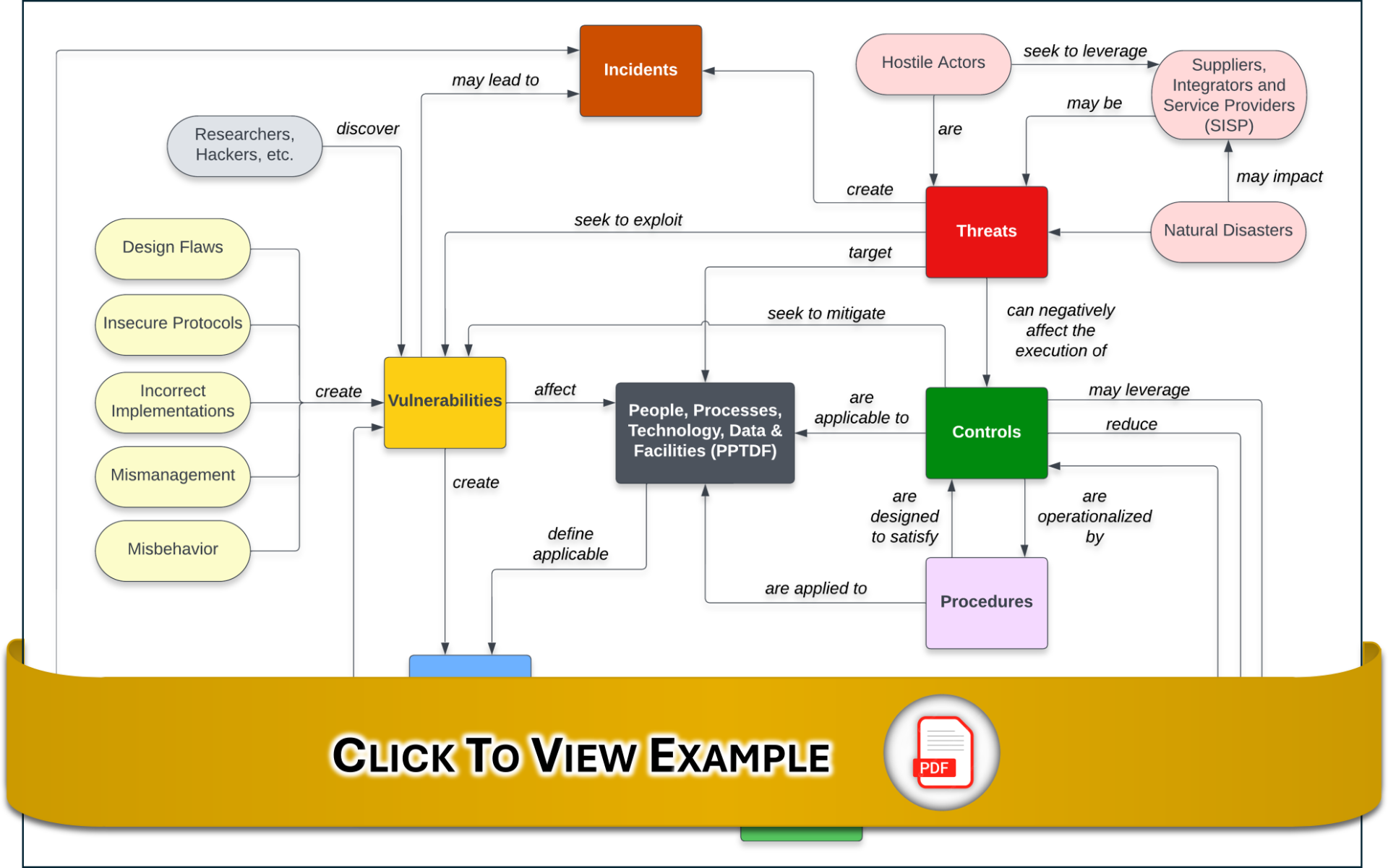
The latest version of the RMP is aligned with the Secure Controls Framework (SCF) Risk Management Model (SCR-RMM) that provides a very flexible approach to risk management. This ties in with the Cybersecurity Risk Assessment (CRA) template product that is also aligned with the SCR-RMM, so it compliments the RMP by having a repeatable, professional template for performing controls-based risk assessments.
Our products are one-time purchases with no software to install - you are buying Microsoft Office-based documentation templates that you can edit for your specific needs. If you can use Microsoft Office or OpenOffice, you can use this product! The RMP is an editable Microsoft Word document that providers program-level guidance to directly supports your organization's policies and standards for managing cybersecurity risk. Unfortunately, most companies lack a coherent approach to managing risks across the enterprise:
- When you look at getting audit ready, your policies and standards only cover the "why?" and "what?" questions of an audit. This product addresses the “how?” questions for how your company manages risk.
- The RMP provides clear, concise documentation that provides a "paint by numbers" approach to how risk is managed.
- The RMP addresses fundamental needs when it comes to what is expected in cybersecurity risk management:
- How risk is defined.
- Who can accept risk.
- How risk is calculated by defining potential the impact and likelihood.
- Necessary steps to reduce risk.
- Risk considerations for vulnerability management.
- The RMP is based on leading frameworks, such as NIST Risk Management Framework (NIST 800-37 rev2), NIST 800-39, ISO 31010 and COSO 2013.
- Just as Human Resources publishes an “employee handbook” to let employees know what is expected for employees from a HR perspective, the RMP does this from a cybersecurity risk management perspective.
No Software To Install
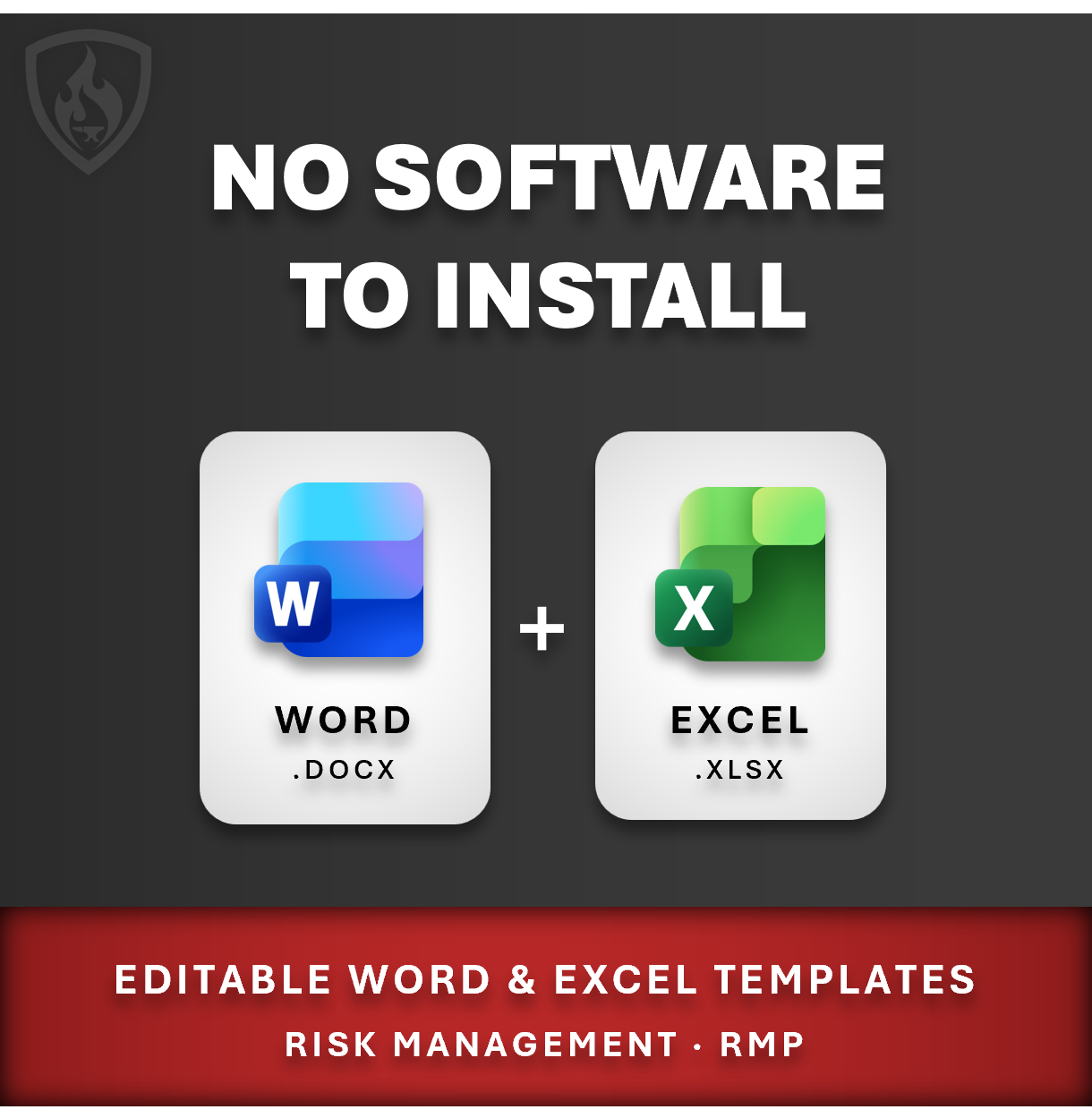
The RMP is a one-time purchase of editable Microsoft Office-based documentation templates. There is no software to install, no agent to deploy, no account to provision, and no cloud environment to configure. If the organization can open and edit Microsoft Word files, the RMP is ready to use.
Microsoft Word
Delivered as fully editable .docx files. Compatible with Word 2016 and newer, Microsoft 365, OpenOffice, LibreOffice, and Google Workspace. The paired CRA template is delivered as Microsoft Excel.
Email Delivery
Documentation is delivered via email download link within 1-2 business days of purchase, often the same business day. There is no installer, no license server, and no activation step.
One-Time Purchase
A single-entity license is included with purchase. There is no recurring subscription requirement, although an optional update subscription is available to stay current as risk management frameworks evolve.
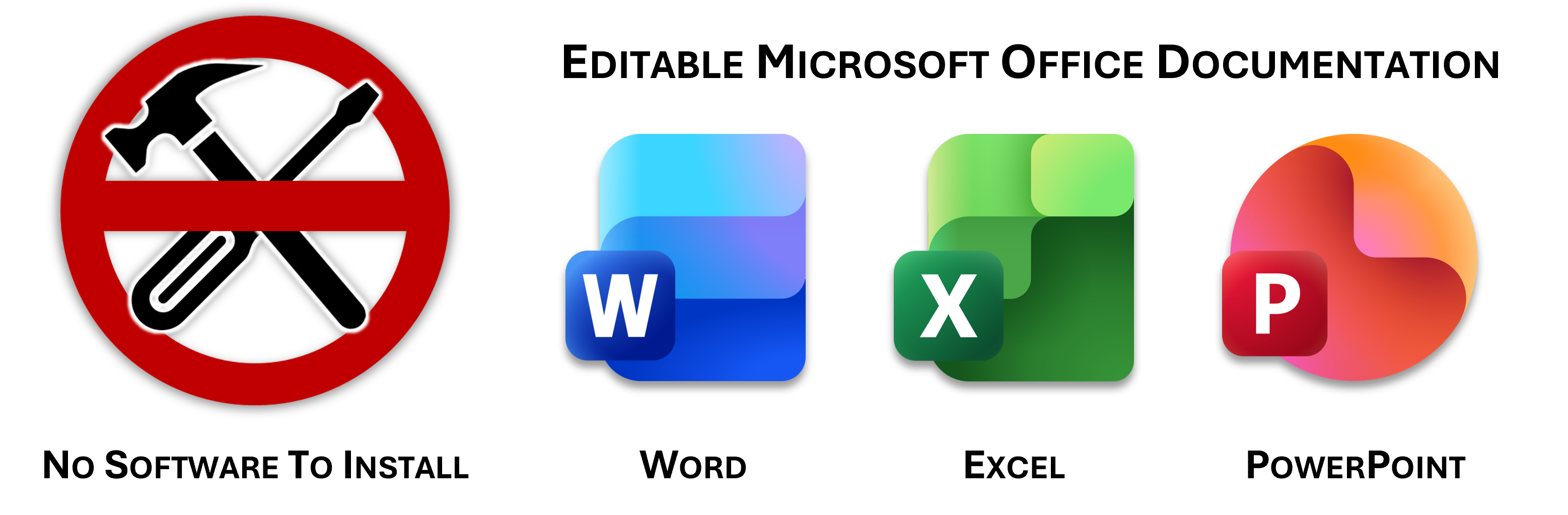
This deployment model is intentional. Risk management documentation benefits from being in the organization's own hands, inside its own document management systems, rather than locked inside a vendor's SaaS tool. Once delivered, this product belongs to the buyer.
What Problems Does the RMP Solve?
Lack Of In-House Security Experience
Writing security documentation is a skill that many good cybersecurity professionals simple are not proficient at and avoid the task at all cost. Tasking your security analysts and engineers to write comprehensive documentation means you are actively taking them away from protecting and defending your network, which is not a wise use of their time. The RMP is an efficient method to obtain comprehensive risk management documentation for your organization!
Compliance Requirements
Requirements such as PCI DSS, HIPAA, MA 201 CMR 17.00 and NIST 800-171 establish a mandate to formally manage risk. The RMP addresses these compliance requirements!
Audit Failures
Similar to vulnerability management, most organizations run into trouble in audits when asked HOW risk is managed, since they cannot provide documentation beyond policies and standards. The RMP addresses the HOW for you!
Vendor Due Diligence Requirements
It is very common for clients and partners to request evidence of a risk management program during their due diligence. The RMP provides this evidence!
How Does the RMP Solve These Problems?
The RMP addresses each risk management documentation challenge with concrete, measurable outcomes. It is designed to take an organization from a blank document to a defensible, customizable risk management program in weeks rather than months — with a controls-based assessment template included for the actual risk assessment work.
Clear Documentation
The RMP provides the comprehensive documentation to prove that your risk program exists.
Time Savings
The RMP provides actionable guidance on what steps can be taken to categorize, calculate and manage risk in a sustainable manner.
Alignment With Leading Practices
The RMP is written to support COSO, COBIT, NIST and ISO frameworks that provide you with significant flexibility.
What Is Included?
The RMP is delivered as editable Microsoft Office documentation. Purchase includes a single-entity license, the first year of product updates, and the Cybersecurity Risk Assessment (CRA) template that pairs with the RMP to provide a controls-based risk assessment format.
The Cybersecurity Risk Management Program (RMP) includes the following content to establish a comprehensive basis for defining and documenting how your company manages cybersecurity risk:
- What Is Risk?
- Risk Management Activities
- Risk Management Benefits
- Who Has The Authority To Manage Risk
- Risk Management Decisions
- Low Risk
- Medium Risk
- High Risk
- Severe Risk
- Extreme Risk
- Risk Management Principles
- Risk Management Maturity Levels
- Defining The Risk Appetite
- Situation Awareness
- Analyzing Risks
- Evaluating & Prioritizing Risks
- Risk Treatment
- Monitoring Risk
- Documenting Risk & Reporting Findings
- COSO – Strategic (Enterprise-Level Approach to Risk Management)
- ISO – Operational (Initiative / Program-Level Approach to Risk Management)
- NIST – Tactical (Asset / Project-Level Approach to Risk Management)
- Sources of Risk
- Risk Roles & Responsibilities
- Risk Assessment Techniques
CRA Template Pairs Directly With The RMP
The Cybersecurity Risk Assessment (CRA) template is the operational counterpart to the RMP. The RMP defines how risk is managed at the program level; the CRA gives the repeatable format for performing the actual controls-based risk assessments. Both are aligned with the SCF Risk Management Model (SCR-RMM), so the RMP and CRA work together as one integrated risk management capability.
Cost Savings Estimate
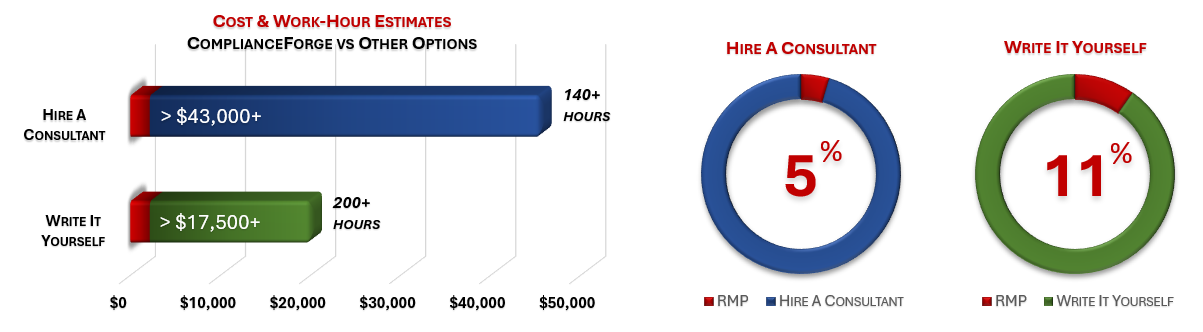
When you look at the costs associated with either (1) hiring an external consultant to write cybersecurity documentation for you or (2) tasking your internal staff to write it, the cost comparisons paint a clear picture that buying from ComplianceForge is the logical option. Compared to hiring a consultant, you can save months of wait time and tens of thousands of dollars. Whereas, compared to writing your own documentation, you can potentially save hundreds of work hours and the associated cost of lost productivity. Purchasing the RMP from ComplianceForge offers these fundamental advantages when compared to the other options for obtaining quality cybersecurity documentation:
Internal Staff Cost
For your internal staff to generate comparable documentation, it would take them an estimated 200 internal staff work hours, which equates to a cost of approximately $17,500 in staff-related expenses. This is about 3 to 6 months of development time where your staff would be diverted from other work.
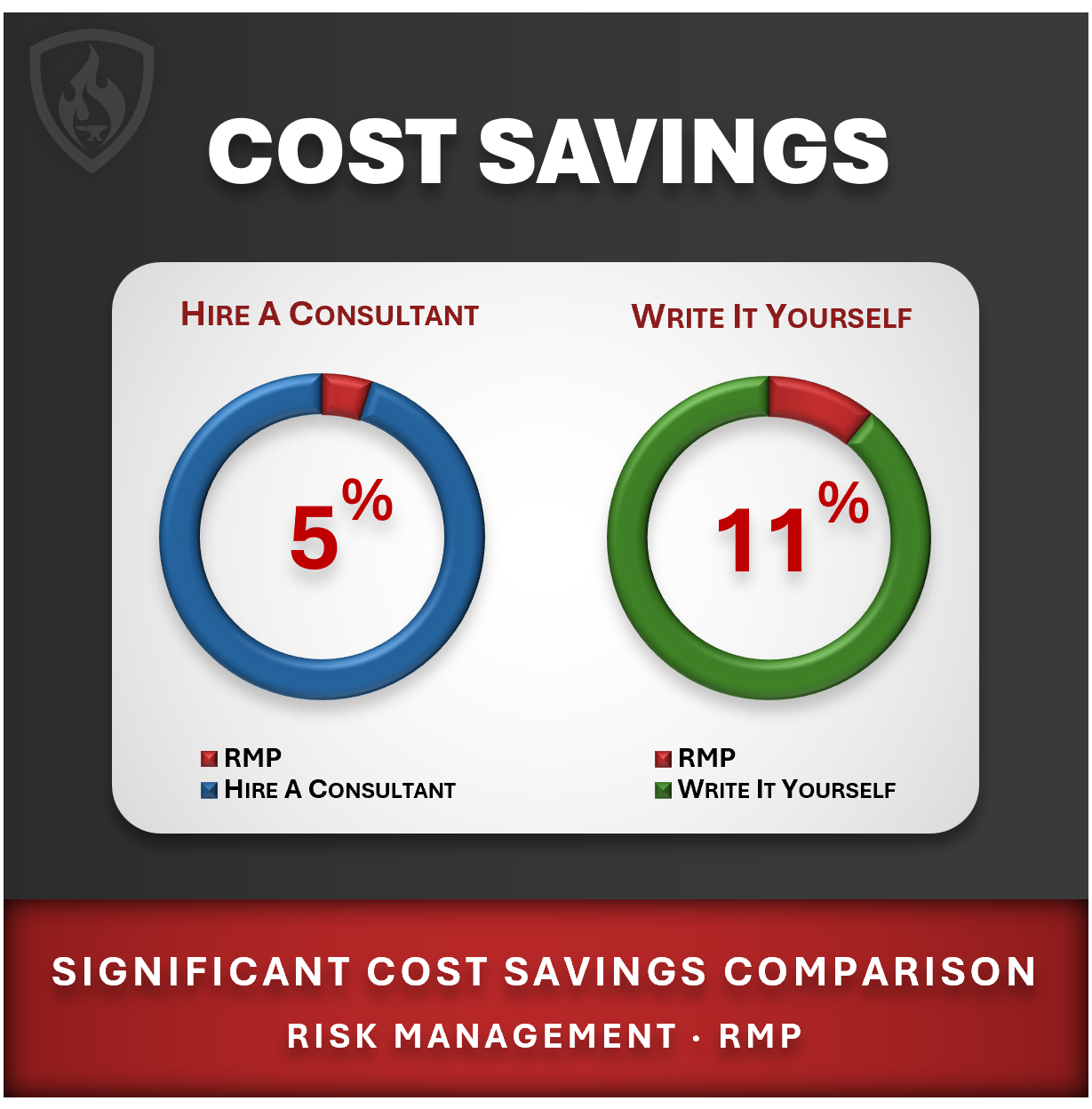
The RMP is approximately 11% of the cost for your internal staff to generate equivalent documentation.
External Consultant Cost
If you hire a consultant to generate this documentation, it would take them an estimated 140 consultant work hours, which equates to a cost of approximately $43,000. This is about 2 to 3 months of development time for a contractor to provide you with the deliverable.
The RMP is approximately 5% of the cost for an external consultant to generate equivalent documentation.
Product Examples
Regardless if your cybersecurity program aligns with NIST, ISO, COBIT, ENISA or another framework, the RMP is designed to address the strategic, operational and tactical components of risk management to provide cybersecurity risk management governance. Policies & standards are absolutely necessary to an organization, but they fail to describe HOW risk is actually managed. The RMP provides this middle ground between high-level policies and the actual procedures of how risk is managed on a day-to-day basis by those individual contributors who execute risk-based controls.
The PDF example below shows representative content from the RMP so the quality and structure of the documentation can be evaluated before purchase.
Below is a PDF example containing a sample of the policies & standards you would receive upon purchasing the RMP.

How Much Customization Remains?
Given the difficult nature of writing templated risk management documentation, ComplianceForge aims for approximately an 80% solution because it is impossible to write a 100% cookie-cutter document that can be equally applied across every organization. Risk management depends on the specific organization's risk appetite, risk tolerance, and governance structure, so the remaining work is fine-tuning the RMP with the specific information that only the organization knows.
In practice, customization is filling in the blanks and following the guidance provided to identify the who, what, when, where, why, and how for the specific risk environment. Typical customization tasks include adding the company name and logo, naming the risk approvers and risk owners, tailoring impact and likelihood scales, defining the risk register format, and removing sections that do not apply to the organization.

Professional Services
ComplianceForge offers optional professional services to customize purchased documentation. Professional services are not required to customize ComplianceForge documentation. However, some clients want our subject matter expertise to help customize their documentation to meet their specific business needs. We offer the following professional service bundles:
5-Hour Bundle
This includes five (5) hours of professional services, which may be beneficial for companies that need some guidance on getting started with how to tailor their documentation.
10-Hour Bundle
This includes ten (10) hours of professional services, which may be beneficial for companies that need additional guidance on tailoring their documentation to meet their compliance requirements.
20-Hour Bundle
This includes twenty (20) hours of professional services, which may be beneficial for companies that need robust services, beyond just 10 hours, to assist in tailoring their documentation to meet their compliance requirements.
Purchased professional service hours expire 120 days (4 months) from the time of purchase if unused. Hours are intended to supplement, not replace, your own customization work, since only your organization knows the exact details to tailor your documentation. For questions regarding scoping a professional services engagement or configuring a custom package, contact ComplianceForge directly through the Contact Us page.
Why Risk Management Documentation Matters
Formal cybersecurity risk management documentation has become a baseline expectation across regulatory, contractual, and customer due-diligence contexts. NIST 800-171 Section 3.11 requires risks to be periodically assessed. PCI DSS Section 12.2 requires companies to perform a formal risk assessment. HIPAA Security Rule requires accurate and thorough assessment of potential risks. MA 201 CMR 17.00, Oregon ITPA, GLBA Safeguards Rule, and the FTC Act Section 5 all carry related risk-assessment obligations. The SEC cybersecurity disclosure rule for public companies requires materiality assessment of cybersecurity risks.
Vendor contracts increasingly require recurring risk assessments. Not having a cybersecurity risk management program can lead to breach of contract, lost bids, and elevated insurance premiums. The RMP provides a complete, defensible risk management baseline that can be customized to the organization's risk appetite and governance structure in weeks rather than months.
The RMP serves as a foundational element in your organization's cybersecurity risk program. It can stand alone or be paired with other specialized products we offer.
Even with larger organizations that have Enterprise Risk Management (ERM) departments, the RMP can tie into the broader risk management framework for any organization. What ComplianceForge.com did was simply reduce the complexity by creating a usable risk management framework that any company can implement to manage risks:
- How risk is categorized
- Risk management fundamentals
- Risk maturity levels
- Defining risk appetite & risk tolerance thresholds
- Evaluating & prioritizing risks
- Risk treatment
- Documenting risk & reporting findings
- Defining potential impact
- Defining potential likelihood
- Defining criticality levels for assets / systems / data
- Sources of risk
CRA Template Pairs With The RMP
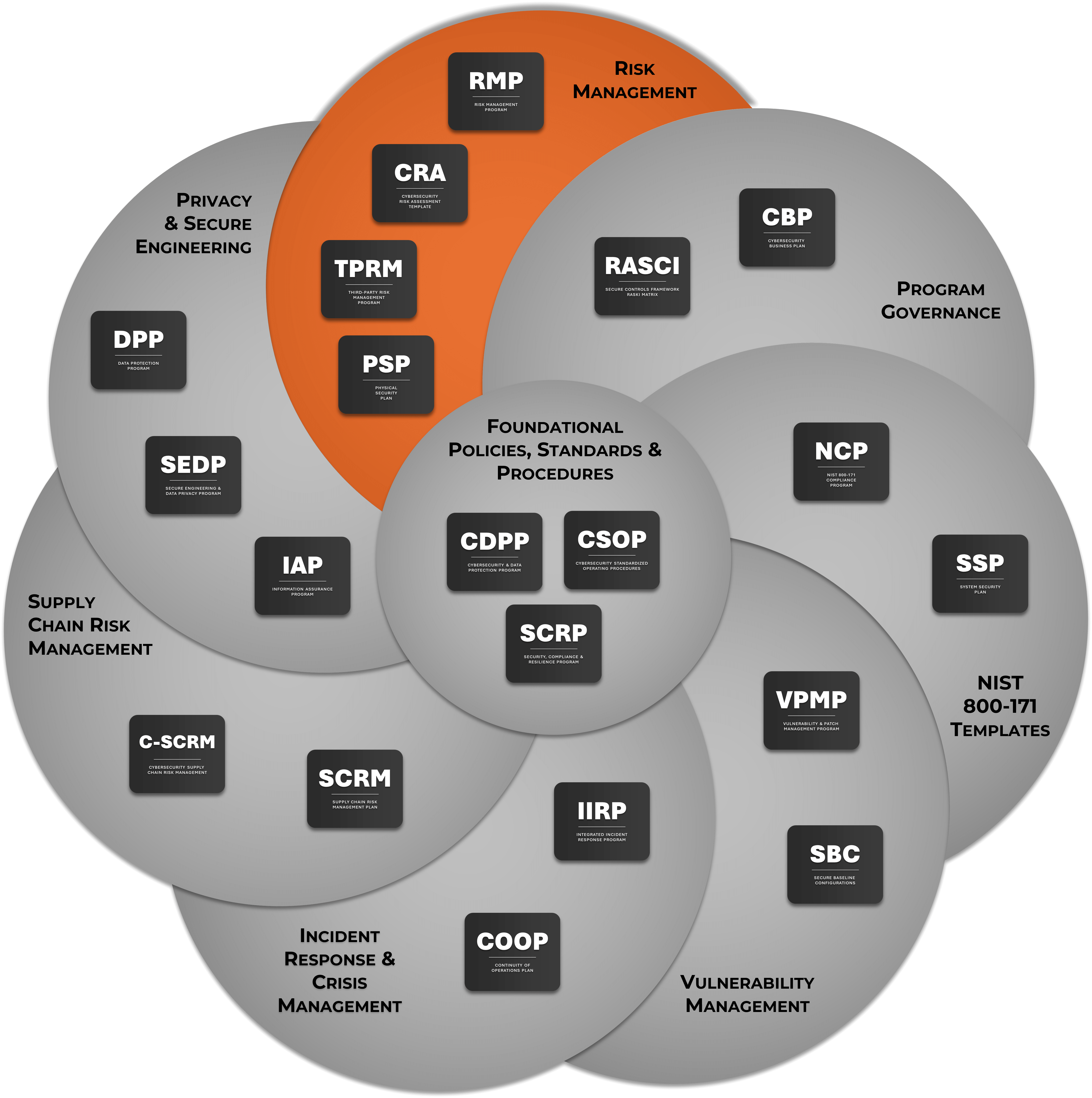
The Cybersecurity Risk Assessment (CRA) template is the operational counterpart to the RMP. The RMP defines how risk is managed at the program level; the CRA gives the repeatable, professional format for performing the actual controls-based risk assessments. Both products are aligned with the Secure Controls Framework (SCF) Risk Management Model (SCR-RMM), so they integrate as one capability rather than two disconnected templates.
The CRA template is also available as a standalone product for organizations that already have a risk management program in place and only need a professional risk assessment format. Together, the RMP and the CRA address both the how (program-level risk governance) and the what (the assessment artifact itself) of cybersecurity risk management.
Based on NIST 800-37 Rev2, COSO 2013, COBIT 5 & ISO 31010 Best Practices!
The RMP is an editable Microsoft Word document that contains the requirements needed to establish a risk management program. Quite simply, the Cybersecurity Risk Management Program (RMP) provides your company with evidence that a documented risk management program exists to address operational risks associated with information and technology. From a Capability Maturity Model (CMM) perspective, if a risk program is not documented, incomplete or ad-hoc, it could be a liability for a company, since it indicates negligence with a statutory, regulatory or contractual requirement to manage risk. The RMP addresses the due care component of getting an organization to a mature level for managing risk.
Reasonable Expectations For Managing Risk
Are you prepared to answer the "why" or "how" questions for your risk assessments? It is a pretty scary question for many people, since their risk assessments are not based on anything beyond “gut feelings” and are overly subjective. When an auditor comes knocking, it is critically important to be able to point to program documentation that justifies your decisions. The Cybersecurity Risk Assessment Framework is intended to be the foundational documentation that you implement to define and manage risk at your company.
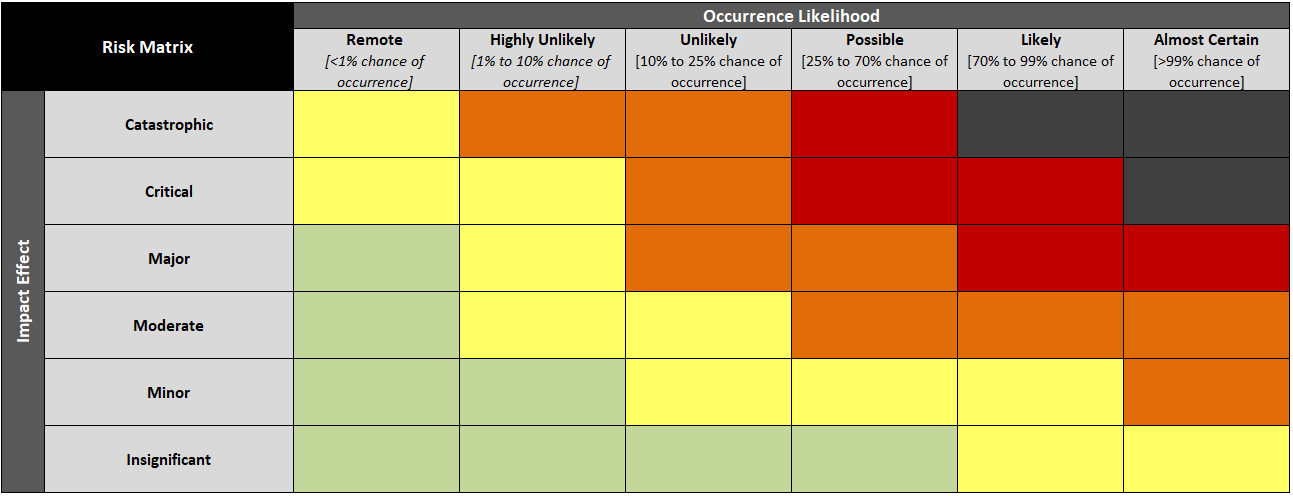
The Cybersecurity Risk Management Program clearly lays out and defines cybersecurity risk for your organization - how you plan to address risk management at the strategic, operational, and tactical levels! This is based on industry-recognized best practices for risk management from COSO, ISO and NIST, so the framework is based on what reasonable expectations are for managing cybersecurity risk. For simple risk assessments, the 6x6 risk matrix can be used to quickly identify the appropriate level of risk the scenario represents. With that knowledge, it is easy to then escalate the risk to the appropriate level of management for resolution (e.g., accept, transfer, mitigate or avoid the risk).
Understanding Layers of Risk
Dependencies are of critical importance when assessing risk, since risk can have a cascading effect. Ideally, a risk assessment at a tactical level (e.g., assessment of a specific application or host) should leverage existing risk assessments that address “upstream” risks. For example, a well-designed and securely-coded application could be compromised if the host system it is running on is insecure. Similarly, the application could be made unavailable if the datacenter lacks measures to ensure uptime against natural or man-made threats.
As part of overall risk management, your company should perform several formal risk assessments, which are meant to be used as references for more detailed project-specific risk assessments. At a minimum, risk assessments should exist for commonly-leveraged aspects of your company's IT environment:
- Datacenters (including infrastructure risks)
- Secure configurations for hosts and major applications (e.g., databases, email, Intranet)
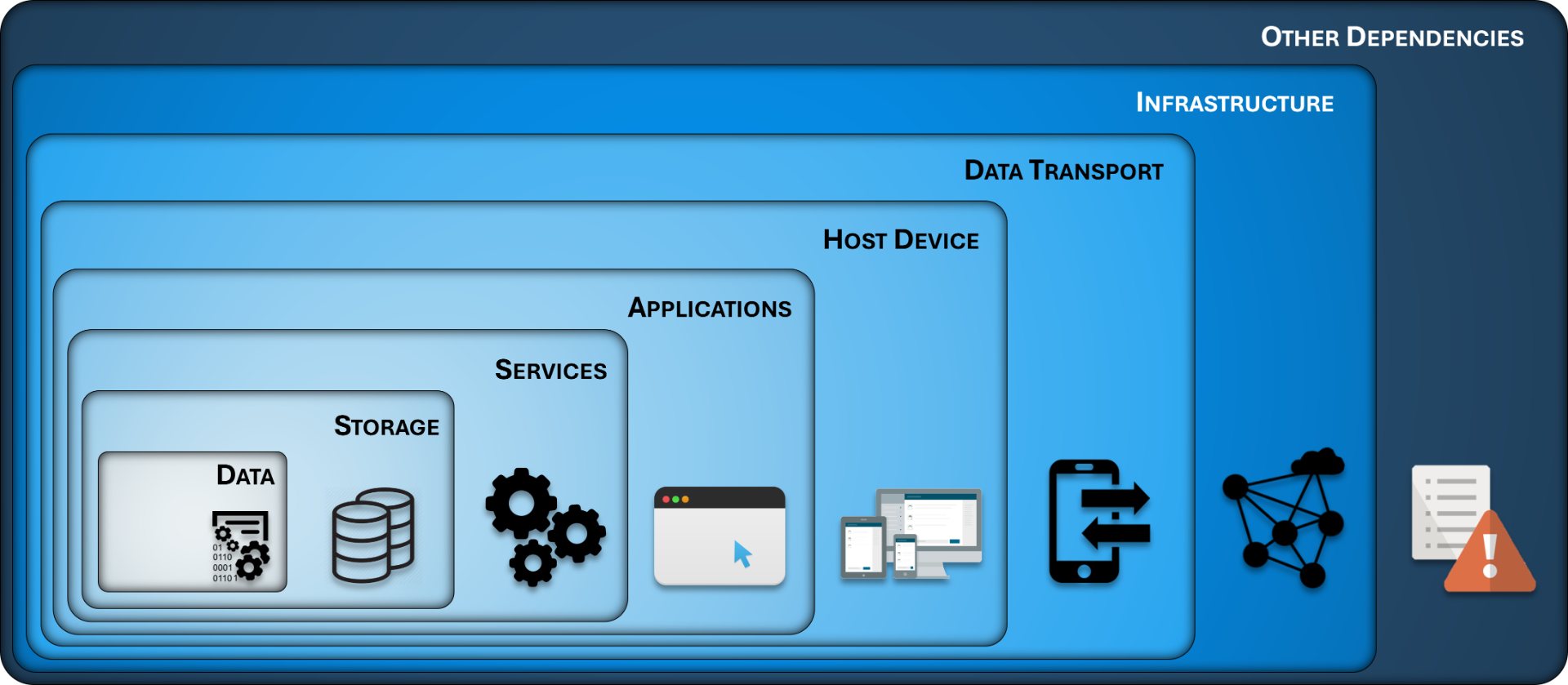
By being able to leverage those existing risk assessments, it will allow for more efficient assessments of applications. The RMP helps build this foundation for efficient risk management by framing risk according to the following concepts:
- Insecure code (developers did not follow secure coding practices)
- Default/weak credentials
- Weak encryption
- Passwords/sensitive data stored in clear text
- Permissions management
- Missing software patches
- Logging/monitoring not being performed
- Lack of system hardening
- Default/weak credentials
- Lack of encryption at rest
- Role-Based Access Control (RBAC)
- Missing software patches
- Logging/monitoring not being performed
- Backups not being performed
- Improper equipment (e.g., consumer-grade networking hardware vs business/enterprise-grade)
- Lack of system hardening
- Default/weak credentials
- Lack of encryption in transit
- Role-Based Access Control (RBAC)
- Missing software patches
- Logging/monitoring not being performed
- Physical access controls
- Environmental controls
- Redundant utilities
- Trained response personnel (disaster recovery plan)
- Software escrow agreements
- Developer/vendor management
- Trans-border data transfers (international law ramifications)
- Business limitations (e.g., timelines, funding, regulations, politics, etc.)