
- Editable Microsoft Word documentation that establishes your organization's privacy program - no software to install.
- Mapped to the SCF Privacy Management Principles (PMP) and covers GDPR, CCPA/CPRA and other US state privacy laws.
- Includes privacy notices, DPIA templates, data subject rights procedures, breach notification procedures and vendor/processor management documentation.
- Immense time & cost savings - enables subject matter experts to fill in the details that only they know.
Don't Write It From Scratch.
GDPR, CCPA/CPRA, and a growing list of US state privacy laws all expect you to show how personal data is governed across its lifecycle. If a regulator or a customer's privacy questionnaire asked for your documented privacy program, could you produce it, or would you be starting from a blank page? Most teams understand the obligation but lack the time and privacy expertise to build defensible documentation, which is why this work so often goes to expensive consultants. The Data Privacy Program (DPP) gives you a running start: editable privacy policies, public-facing notices, DPIA templates, data subject rights and breach notification procedures, and vendor management documentation, mapped to the Secure Controls Framework privacy management principles and aligned to GDPR, CCPA/CPRA, and other state laws. It gets you roughly 80 to 90 percent of the way there, then your team tailors it to your data processing activities and jurisdictions.
The Data Privacy Program (DPP) is a comprehensive set of editable privacy documentation designed to operationalize privacy program requirements across major frameworks and regulations. The DPP is mapped to the Secure Controls Framework (SCF) Privacy Management Principles (PMP) and covers GDPR (EU General Data Protection Regulation), CCPA and CPRA (California privacy laws), and other state-level US privacy laws including Virginia, Colorado, Connecticut, and Utah. For organizations that need defensible privacy documentation to support regulatory compliance, customer questionnaires, and audit readiness, the DPP provides a turnkey starting point that would otherwise take months to develop internally.
The DPP is more than a single policy document. It is a structured program covering privacy policies, public-facing privacy notices, Data Protection Impact Assessment (DPIA) templates, data subject rights procedures, breach notification procedures, vendor and processor management documentation, and supporting templates that operationalize privacy program execution. Each component is editable Microsoft Office content that you tailor to your organization's specific data processing activities, jurisdictions, and roles.
The DPP is a one-time purchase with no software to install - you are buying Microsoft Office-based documentation templates that you can edit for your specific needs. If you can use Microsoft Office or OpenOffice, you can use this product! The DPP is capable of scaling for any sized company.
- The DPP is an editable Microsoft Word document that provides program-level guidance to directly support your company's policies and standards for ensuring secure engineering and privacy principles are operationalized.
- This product addresses the “how?” questions for how your company ensures privacy principles are operationalized.
Product Walkthrough Video
What Does This Product Walkthrough Cover?
To help explain the product in more detail, below is a product video that will give a walkthrough of our product. It will give a brief overview of what it is, what is included within the download, how the cost compares with writing it internally versus hiring a consultant, and how much customization remains when it arrives.
The walkthrough covers the same sections you will find further down this page, so you can either read through the detail here or watch it summarized first. Chapter timestamps are included to the right of the video, so if you only want to watch one part, such as what is included within the download or what the cost comparison goes over, you can jump straight to it.
- 0:00 Introduction
- 0:22 Overview
- 2:36 What Is The DPP?
- 4:37 No Software To Install
- 6:08 What Problems Does It Solve?
- 7:29 How Does It Solve Them?
- 8:11 What Is Included?
- 9:12 Cost Savings
- 10:04 Examples
- 10:24 Customization
- 11:14 Professional Services
- 11:55 Cybersecurity By Design & Data Privacy By Design
- 12:48 Questions? Contact Us.
What Is The Data Privacy Program?
The Data Privacy Program (DPP) is an editable "privacy program template" that exists to ensure data protection-related controls are adequately identified and implemented across your systems, applications, services, processes and other initiatives, including third-party service providers. The DPP prescribes a comprehensive framework for the collection, creation, use, dissemination, maintenance, retention, and/or disclosure of Personal Data / sensitive Personal Data (PD / sPD). ComplianceForge designed the DPP for cybersecurity and privacy personnel who are tasked with "privacy compliance" for their organization. This involves advising privacy stakeholders on Privacy by Design (PbD) matters, while providing oversight to your organization's executive management that stakeholders are being held accountable for their associated data privacy practices.
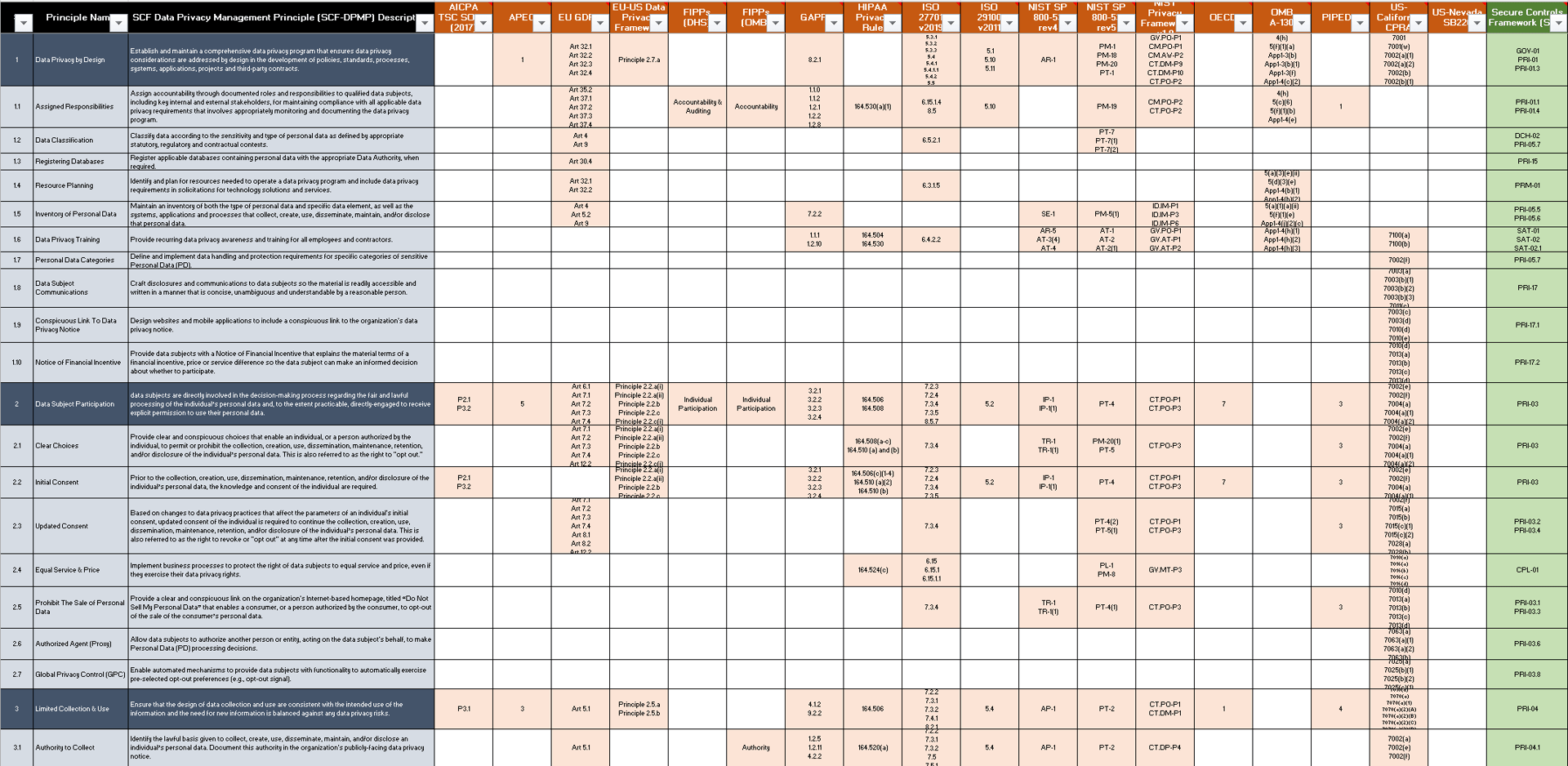
The DPP is a "Rosetta Stone" approach to privacy principles. Based on our experience, we understand that most smaller-to-medium-sized businesses lack the knowledge and experience to undertake such privacy program documentation efforts. That means businesses are faced to either outsource the work to expensive privacy consultants, write it themselves or ignore the requirement in hopes of not getting in trouble for being non-compliant. To solve this issue, ComplianceForge chose to leverage the Secure Controls Framework Data Privacy Management Principles (SCF DPMP) as an efficient way to align with an assortment of "privacy principles" that organizations are faced with.
The SCF DPMP is a “Rosetta Stone” of data privacy management principles that maps to the following privacy practices:
- AICPA’s Trust Services Criteria (TSC) (2017)
- Asia-Pacific Economic Cooperation (APEC)
- California Privacy Rights Act (CPRA)
- European Union General Data Protection Regulation (EU GDPR)
- Fair Information Practice Principles - Department of Homeland Security (DHS FIPPs)
- Fair Information Practice Principles - Office of Management and Budget (OMB FIPPs)
- Generally Accepted Privacy Principles (GAPP)
- HIPAA Privacy Rule
- ISO/IEC 27701:2019
- ISO/IEC 29100:2011
- Nevada SB820
- NIST SP 800-53 R4
- NIST SP 800-53 R5
- NIST Privacy Framework v1.0
- OASIS Privacy Management Reference Model (PMRM)
- Organization for Economic Co-operation and Development (OECD)
- Office of Management and Budget (OMB) - Circular A-130
- Personal Information Protection and Electronic Documents Act (PIPEDA)
- Privacy by Design (PbD) – The 7 Foundational Principles
When you look at a comparison of privacy-relevant laws, regulations and frameworks, you will see a wide variety of expectations. The SCF DPMP's solution to the apples-to-oranges comparison was to create a metaframework of privacy principles that covers nineteen (19) privacy frameworks to provide the ability to demonstrate adherence to multiple privacy principles.
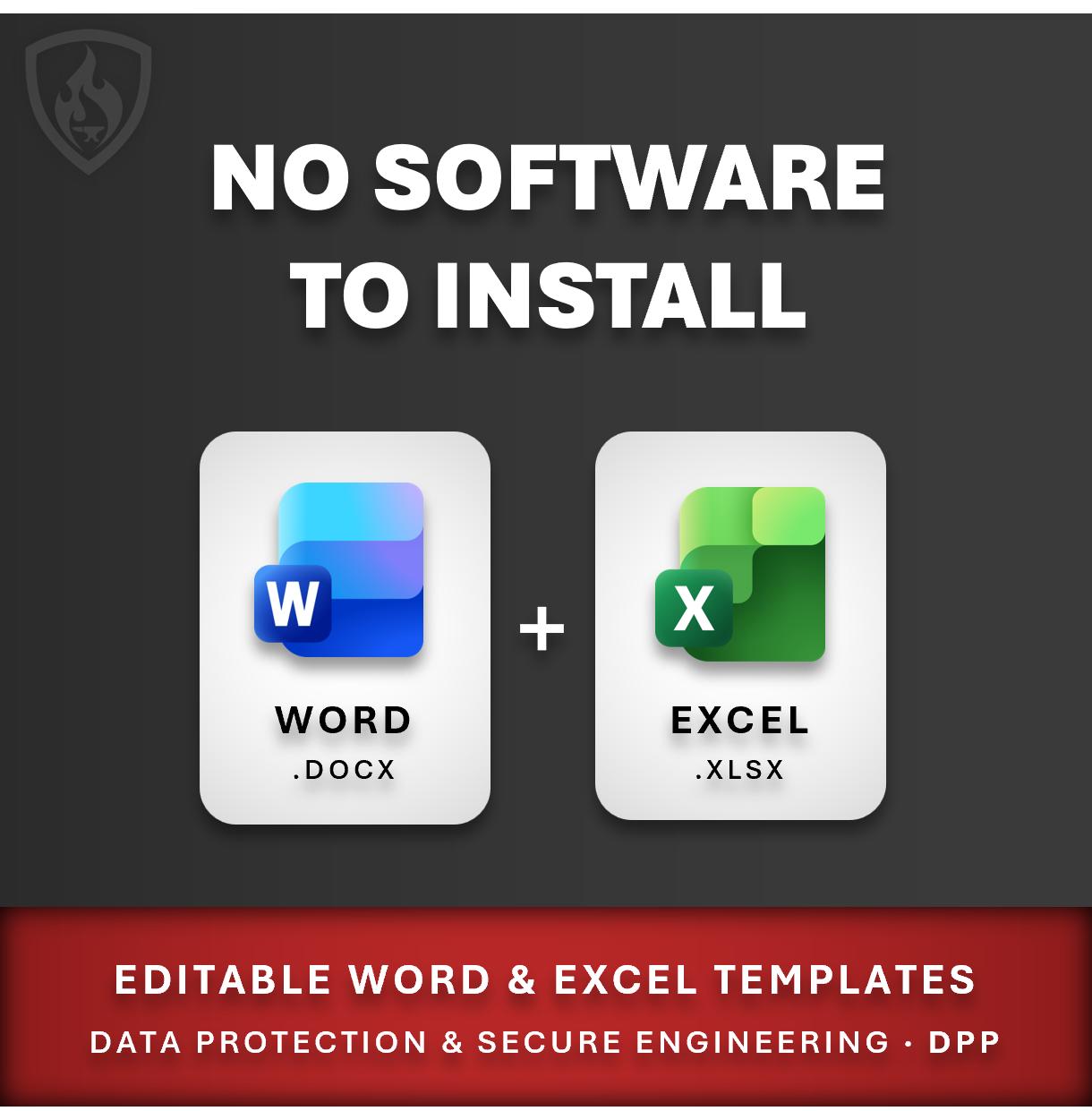
No Software To Install
The DPP is editable Microsoft Office documentation. There is no software to install, no agent to deploy, no SaaS account to provision, and no cloud environment to configure. If your organization can open and edit Microsoft Word and Excel files, you can use the DPP immediately. This deliberate choice keeps privacy documentation in your own document control workflow where legal, privacy, and compliance teams can review, customize, and approve content using familiar tools.
Microsoft Word and Excel
Privacy policies, notices, DPIA template, and procedures are delivered as .docx files. Records of processing activities and supporting registers are delivered as .xlsx files. Compatible with Word and Excel 2016 and newer, Microsoft 365, OpenOffice, LibreOffice, and Google Docs and Sheets.
Box Delivery
Documentation is delivered as a secure Box link via email after purchase. No account creation, no software install, no waiting period. Download once and own the files; customize at your own pace within your own document control environment.
Plain English Content
Public-facing notices use plain language that meets transparency requirements without requiring legal interpretation for end users. Internal policies and procedures use clear operational language that translates regulatory requirements into actionable practice for privacy, security, and operations teams.
This delivery model is intentional. Privacy documentation belongs in your own document control workflow where it can be approved by your legal and compliance teams, integrated with your data inventory, and made available to regulators and customers during audits and questionnaires.
What Problems Does The DPP Solve?
Organizations subject to GDPR, CCPA, CPRA, or other privacy regulations face predictable challenges building defensible privacy documentation from scratch. The DPP is designed to address each of these challenges with a coherent, regulator-aligned starting point.
Lack of In House Security Experience
Writing cybersecurity & privacy documentation is a skill that most cybersecurity professionals simply are not proficient at and avoid the task at all cost. Tasking your security analysts and engineers to write comprehensive data privacy documentation means you are actively taking them away from protecting and defending your network, which is not a wise use of their time. The DPP is an efficient method to obtain comprehensive guidance documentation to implement privacy principles within your organization!
Compliance Requirements
Requirements such as EU GDPR require companies that store, process or transmit the personal data of EU citizens to ensure that both cybersecurity and privacy principles are built into processes by default. Can you prove how privacy principles are implemented at your organization?
Audit Failures
Cybersecurity and privacy documentation does not age gracefully like a fine wine. Outdated documentation leads to gaps that expose organizations to audit failures and system compromises. The DPP provides mapping to leading privacy frameworks to show you exactly what is required to both stay secure and compliant.
Vendor Requirements
It is becoming more common for clients and partners to request evidence of a privacy program and this includes policies, standards and procedures. With EU GDPR, vendors and other partners will be expected to demonstrate evidence of compliance with the EU GDPR.
How Does The DPP Solve These Problems?
The DPP addresses each privacy program challenge above with a structured documentation set built on a unified framework and ready for customization to your organization's specific data processing activities.
Clear Documentation
The DPP provides a comprehensive approach to operationalizing privacy principles. This equates to a time saving of hundreds of hours and tens of thousands of dollars in staff and consultant expenses!
Time Savings
The DPP can provide your organization with a templated solution that requires minimal resources to fine tune for your organization's specific privacy needs.
Alignment With Leading Practices
The DPP is written to support leading cybersecurity and privacy frameworks!
What Is Included With The DPP?
At its core, the DPP is an editable Microsoft Word document that establishes your organization's privacy program. It is designed to address the who / what / when / where / why / how concepts that need to exist to operationalize privacy principles. If you take a look through the table of contents in the example listed below, you will see coverage for reasonable privacy program expectations:
- Stakeholder identification and accountability structure
- Applicable privacy-specific laws, regulations and frameworks
- Concept of Operations (CONOPS) - mission, vision, strategy and multi-year roadmap to operationalize the privacy program
- Targeted privacy maturity level
- Organization-specific criteria to meet privacy management principles
- Data classification and handling guidelines
- And more!
Single-Entity License
The DPP is licensed for use by a single entity (your organization and its subsidiaries). For consulting firms or shared use across unrelated organizations, contact ComplianceForge for licensing options. Lifetime access to the version purchased is included; ongoing updates as privacy regulations evolve are available through the optional annual update subscription.
Cost Savings Estimate
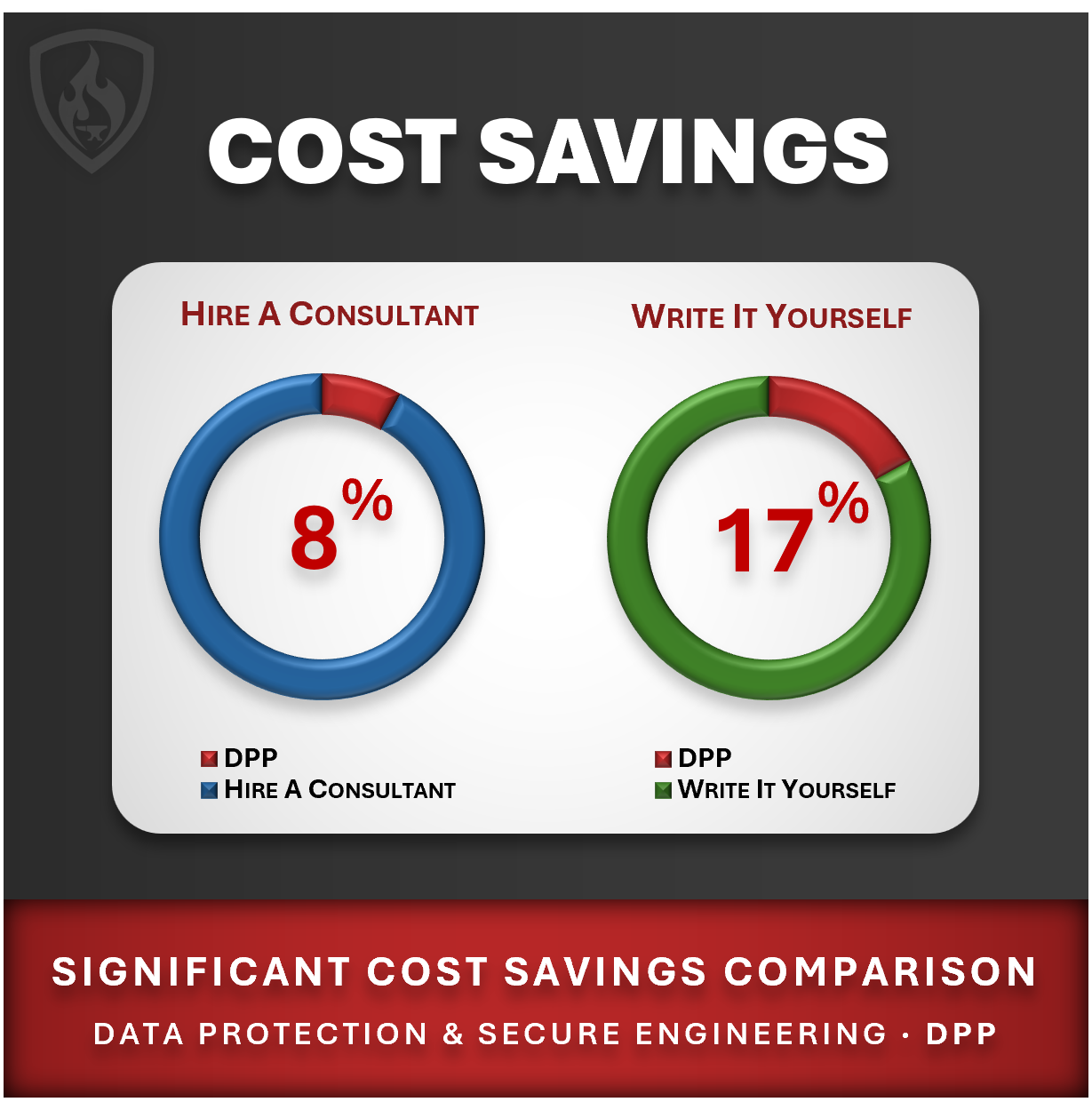
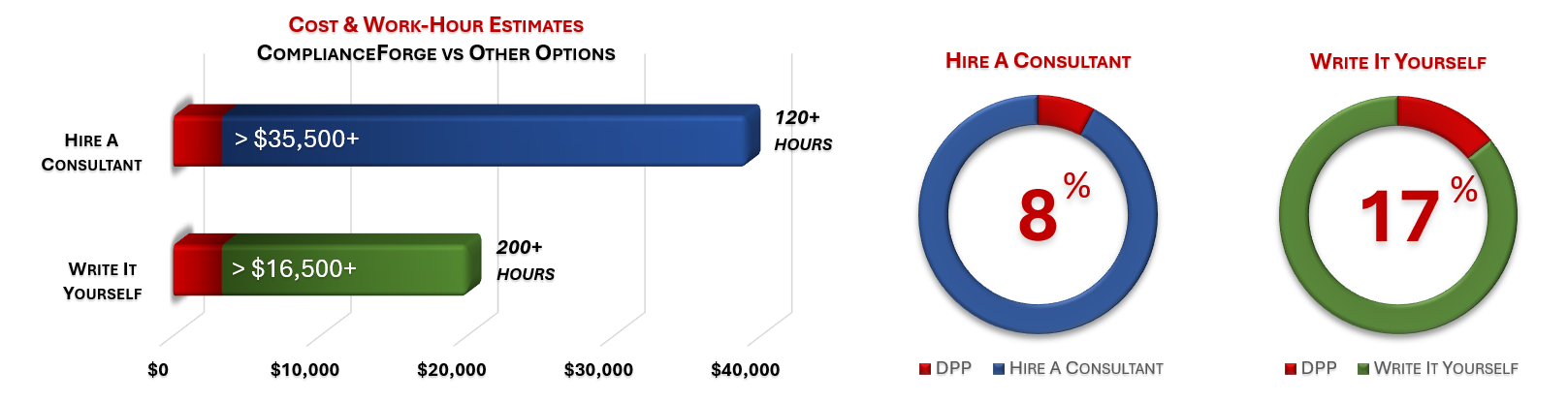
When you look at the costs associated with either (1) hiring an external consultant to write privacy documentation for you or (2) tasking your internal staff to write it, the cost comparisons paint a clear picture that buying from ComplianceForge is the logical option. Compared to hiring a consultant, you can save months of wait time and tens of thousands of dollars. Whereas, compared to writing your own documentation, you can potentially save hundreds of work hours and the associated cost of lost productivity. Purchasing the DPP from ComplianceForge offers these fundamental advantages when compared to the other options for obtaining quality privacy documentation:
Internal Staff Cost
For your internal staff to generate comparable privacy documentation, it would take them an estimated 120 internal staff work hours, which equates to a cost of approximately $16,500 in staff-related expenses. This is about 2 to 4 months of development time where your privacy, legal, and compliance staff would be diverted from other work.
The DPP is approximately 17% of the cost for your internal staff to generate equivalent documentation.
External Consultant Cost
If you hire a consultant to generate this documentation, it would take them an estimated 80 consultant work hours, which equates to a cost of approximately $35,500. This is about 2 to 3 months of development time for a contractor to provide you with the deliverable.
The DPP is approximately 8% of the cost for an external consultant to generate equivalent documentation.
DPP Examples
Downloadable PDF samples show representative content from the DPP, so you can evaluate the depth, structure, and style of the documentation before purchase. The samples illustrate how the SCF Privacy Management Principles framework operationalizes across multiple privacy regulations within a single coherent program.
Sample content typically includes a representative privacy program policy section showing how SCF PMP principles map to GDPR articles and CCPA and CPRA sections simultaneously, a DPIA template excerpt showing the structured assessment approach, and a data subject rights procedure excerpt showing how access and deletion requests are handled with regulatory timing requirements across jurisdictions.
Below is a PDF example containing a sample of the policies & standards you would receive upon purchasing the DPP.

Customization For Your Organization
Given the difficult nature of writing templated policy and standards, we aimed for approximately a "80% solution" since it is impossible to write a 100% complete cookie cutter document that can be equally applied across multiple organizations. This means ComplianceForge did the heavy lifting for you, and all you have to do is fine-tune the policies and standards with the specific information that only you know to make it applicable to your organization. It is pretty much filling in the blanks and following the helpful guidance that we provide to identify the who / what / when / where / why / how to make it complete.
Most organizations complete customization in two to six weeks depending on program complexity and the maturity of existing data inventory work. The DPP is structured to support this process, with explicit placeholders for organization-specific content, worked examples that illustrate intent, and consistent terminology across the documentation set. Privacy and legal teams typically lead customization with input from data inventory, security, and operations stakeholders. The result is a fully owned, fully editable privacy program that reflects your organization rather than a generic template.

Professional Services
ComplianceForge offers optional professional services to customize purchased documentation. Professional services are not required to customize ComplianceForge documentation. However, some clients want our subject matter expertise to help customize their documentation to meet their specific business needs. We offer the following professional service bundles:
5-Hour Bundle
This includes five (5) hours of professional services, which may be beneficial for companies that need some guidance on getting started with how to tailor their documentation.
10-Hour Bundle
This includes ten (10) hours of professional services, which may be beneficial for companies that need additional guidance on tailoring their documentation to meet their compliance requirements.
20-Hour Bundle
This includes twenty (20) hours of professional services, which may be beneficial for companies that need robust services, beyond just 10 hours, to assist in tailoring their documentation to meet their compliance requirements.
Purchased professional service hours expire 120 days (4 months) from the time of purchase if unused. Hours are intended to supplement, not replace, your own customization work, since only your organization knows the exact details to tailor your documentation. For questions regarding scoping a professional services engagement or configuring a custom package, contact ComplianceForge directly through the Contact Us page.
Data Protection Program Documentation
The DPP can serve as a foundational element in your organization's privacy program. It can stand alone or be paired with other specialized products we offer.
Cybersecurity and privacy do not need to be hard. The Security Engineering & Data Privacy (SEDP) document is meant to simplify how security and privacy can be operationalized in a “paint by numbers” approach. This product is comprised of editable Microsoft Word and Excel documentation so you can customize it for your specific needs.
Please keep in mind that security & privacy engineering principles are widely expected activities:
- European Union General Data Protection Regulation (EU GDPR)
- NIST 800-53
- NIST Cybersecurity Framework
- ISO 27002
- Defense Federal Acquisition Regulations Supplement (DFARS) 252.204-7012 (NIST 800-171)
- Federal Acquisition Regulations (FAR) 52.204-21 - 4
- National Industrial Security Program Operating Manual (NISPOM)
- SOC2
- New York State Department of Financial Service (DFS)
- Payment Card Industry Data Protection Standard (PCI DSS)
- Center for Internet Security Critical Security Controls (CIS CSC)
- Generally Accepted Privacy Principles (GAPP)