- The SCR-CMM defines maturity levels for cybersecurity controls, from non-existent through optimized.
- Maturity targets help organizations plan for, budget for, and assess against attainable goals.
- Not every control needs to be at the highest maturity level. Risk-based targeting is key.
- The CMM integrates with the SCR-RMM and SCRMS to provide a complete GRC operating model.
- The SCR-CMM is a free resource from the Secure Controls Framework.
What Is The SCR-CMM?
The Capability Maturity Model helps organizations define attainable maturity targets for each control, moving beyond binary pass/fail assessments.
The SCR-CMM is designed to work alongside the SCR-RMM and the SCRMS, providing the maturity dimension to the controls-centric approach that the entire SCF ecosystem is built upon.
Traditional compliance assessments often reduce controls to a simple yes/no determination. The SCR-CMM introduces nuance by recognizing that controls exist on a spectrum of maturity, from completely absent to fully optimized. This enables organizations to set realistic targets, track improvement over time, and communicate progress to leadership in meaningful terms.
- Provide CISO/CPOs/CIOs with objective criteria that can be used to establish expectations for a cybersecurity & privacy program;
- Provide objective criteria for project teams so that secure practices are appropriately planned and budgeted for;
- Provide minimum criteria that can be used to evaluate third-party service provider controls; and
- Provide a means to perform due diligence of cybersecurity and privacy practices as part of Mergers & Acquisitions (M&A).
Systems Security Engineering Capability Maturity Model (SSE-CMM) Alignment
The term “nested” regarding maturity, refers to how the SCR-CMM’s control criteria were written to acknowledge that each succeeding level of maturity is built upon its predecessor. Essentially, you cannot run without first learning how to walk. Likewise, you cannot walk without first learning how to crawl. This approach to defining cybersecurity & privacy control maturity is how the SCR-CMM is structured.
The SCR-CMM draws upon the high-level structure of the Systems Security Engineering Capability Maturity Model v2.0 (SSE-CMM), since we felt it was the best model to demonstrate varying levels of maturity for people, processes and technology at a control level. If you are unfamiliar with the SSE-CMM, it is well-worth your time to read through the SSE-CMM Model Description Document that is hosted by the US Defense Technical Information Center (DTIC).
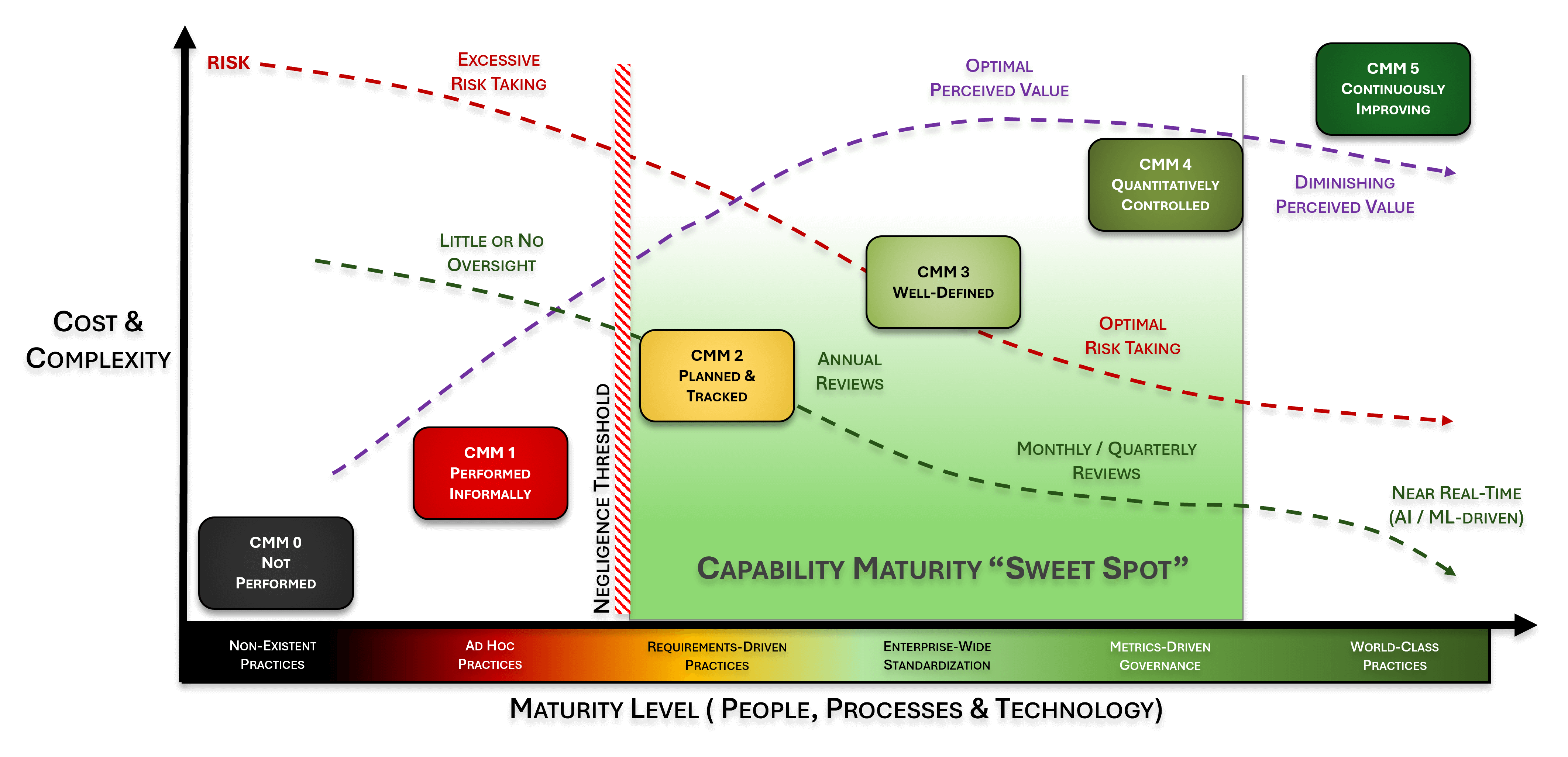
Six Maturity Levels: L0 Through L5
The SCR-CMM defines maturity levels that describe increasing degrees of control effectiveness.
- Practices are non-existent, where a reasonable person would conclude the control is not being performed.
- Evidence of due care and due diligence do not exist to demonstrate compliance with applicable statutory, regulatory and/or contractual obligations.
- For smaller organizations, the IT support role only focuses on “break / fix” work or the outsourced IT provider has a scope in its support contract that excludes the control through either oversight or ignorance of the client’s requirements.
- For medium / large organizations, there is IT and/or cybersecurity staff, but governance is functionally non-existent and the control is not performed through either oversight, ignorance or incompetence.
- Practices are “ad hoc” where the intent of a control is not met due to a lack consistency and formality.
- When the control is met, it lacks consistency and formality (e.g., rudimentary practices are performed informally).
- A reasonable person would conclude the control is not consistently performed in a structured manner.
- Performance depends on specific knowledge and effort of the individual performing the task(s), where the performance of these practices is not proactively governed.
- Limited evidence of due care and due diligence exists, where it would be difficult to legitimately disprove a claim of negligence for how cybersecurity/privacy controls are implemented and maintained.
- For smaller organizations, the IT support role only focuses on “break / fix” work or the outsourced IT provider has a limited scope in its support contract.
- For medium / large organizations, there is IT and/or cybersecurity staff but there is no management focus to spend time or resources on the control.
- Practices are “requirements-driven” (e.g., specified by a law, regulation or contractual obligation) and are tailored to meet those specific compliance obligations (e.g., evidence of due diligence).
- Performance of a control is planned and tracked according to specified procedures and work products conform to specified standards (e.g., evidence of due care).
- Controls are implemented in some, but not all applicable circumstances/environments (e.g., specific enclaves, facilities or locations).
- A reasonable person would conclude controls are “compliance-focused” to meet a specific obligation, since the practices are applied at a local/regional level and are not standardized practices across the enterprise.
- Sufficient evidence of due care and due diligence exists to demonstrate compliance with specific statutory, regulatory and/or contractual obligations.
- For smaller organizations:
- IT staff have clear requirements to meet applicable compliance obligations or the outsourced IT provider is properly scoped in its support contract to address applicable compliance obligations.
- It is unlikely that there is a dedicated cybersecurity role and at best it is an additional duty for existing personnel.
- For medium / large organizations:
- IT staff have clear requirements to meet applicable compliance obligations.
- There is most likely a dedicated cybersecurity role or a small cybersecurity team.
- Practices are standardized “enterprise-wide” where the control is well-defined and standardized across the entire enterprise.
- Controls are implemented in all applicable circumstances/environments (deviations are documented and justified).
- Practices are performed according to a well-defined process using approved, tailored versions of standardized processes.
- Performance of a control is according to specified well-defined and standardized procedures.
- Control execution is planned and managed using an enterprise-wide, standardized methodology.
- A reasonable person would conclude controls are “security-focused” that address both mandatory and discretionary requirements. Compliance could reasonably be viewed as a “natural byproduct” of secure practices.
- Sufficient evidence of due care and due diligence exists to demonstrate compliance with specific statutory, regulatory and/or contractual obligations.
- The Chief Information Security Officer (CISO), or similar function, develops a security-focused Concept of Operations (CONOPS) that documents organization-wide management, operational and technical measures to apply defense-in-depth techniques (note - in this context, a CONOPS is a verbal or graphic statement of intent and assumptions regarding operationalizing the identified tasks to achieve the CISO’s stated objectives. The result of the CONOPS is operating the organization’s cybersecurity and data protection program so that it meets business objectives). Control or domain-specific CONOPS may be incorporated as part of a broader operational plan for the cybersecurity and privacy program (e.g., cybersecurity-specific business plan)
- For smaller organizations:
- There is a small IT staff that has clear requirements to meet applicable compliance obligations.
- There is a very competent leader (e.g., security manager / director) with solid cybersecurity experience who has the authority to direct resources to enact secure practices across the organization.
- For medium / large organizations:
- IT staff have clear requirements to implement standardized cybersecurity & privacy principles across the enterprise.
- In addition to the existence of a dedicated cybersecurity team, there are specialists (e.g., engineers, SOC analysts, GRC, privacy, etc.)
- There is a very competent leader (e.g., CISO) with solid cybersecurity experience who has the authority to direct resources to enact secure practices across the organization.
- Practices are “metrics-driven” and provide sufficient management insight (based on a quantitative understanding of process capabilities) to predict optimal performance, ensure continued operations, and identify areas for improvement.
- Practices build upon established L3 maturity criteria and have detailed metrics to enable governance oversight.
- Detailed measures of performance are collected and analyzed. This leads to a quantitative understanding of process capability and an improved ability to predict performance.
- Performance is objectively managed, and the quality of work products is quantitatively known.
- For smaller organizations, it is unrealistic to attain this level of maturity.
- For medium / large organizations:
- IT staff have clear requirements to implement standardized cybersecurity & privacy principles across the enterprise.
- In addition to the existence of a dedicated cybersecurity team, there are specialists (e.g., engineers, SOC analysts, GRC, privacy, etc.)
- There is a very competent leader (e.g., CISO) with solid cybersecurity experience who has the authority to direct resources to enact secure practices across the organization.
- Business stakeholders are made aware of the status of the cybersecurity and privacy program (e.g., quarterly business reviews to the CIO/CEO/board of directors). This situational awareness is made possible through detailed metrics.
- Practices are “world-class” capabilities that leverage predictive analysis.
- Practices build upon established L4 maturity criteria and are time-sensitive to support operational efficiency, which likely includes automated actions through machine learning or Artificial Intelligence (AI).
- Quantitative performance goals (targets) for process effectiveness and efficiency are established, based on the business goals of the organization.
- Process improvements are implemented according to “continuous improvement” practices to affect process changes.
- For small and medium-sized organizations, it is unrealistic to attain this level of maturity.
- For medium / large organizations:
- IT staff have clear requirements to implement standardized cybersecurity & privacy principles across the enterprise.
- In addition to the existence of a dedicated cybersecurity team, there are specialists (e.g., engineers, SOC analysts, GRC, privacy, etc.)
- There is a very competent leader (e.g., CISO) with solid cybersecurity experience who has the authority to direct resources to enact secure practices across the organization.
- Business stakeholders are made aware of the status of the cybersecurity and privacy program (e.g., quarterly business reviews to the CIO/CEO/board of directors). This situational awareness is made possible through detailed metrics.
- The organization has a very aggressive business model that requires not only IT, but its cybersecurity and privacy practices, to be innovative to the point of leading the industry in how its products and services are designed, built or delivered.
- The organization invests heavily into developing AI/ML technologies to make near real-time process improvements to support the goal of being an industry leader.
Not every control needs to reach Level 5. The appropriate maturity target depends on the control's risk weighting, the organization's risk appetite, and available resources. A Level 3 target is appropriate for most controls in most organizations.
Key Benefits
A maturity-based approach provides practical advantages over binary compliance assessments.
- Realistic goal setting. Attainable targets that can be planned for, budgeted, and assessed against.
- Clear communication. Maturity levels provide a common language between technical teams and executive leadership.
- Risk-based prioritization. Higher-risk controls can be targeted for higher maturity, optimizing resource allocation.
- Measurable progress. Track improvement over time with quantifiable maturity scores.
- Audit readiness. Maturity assessments produce the evidence and documentation auditors expect to see.
Frequently-Asked Questions
Here are answers to common questions about the SCR-CMM: