
- Cybersecurity-focused to implement a program-level incident response governance function.
- Holistic approach to govern each phase of incident response operations.
- Leverages industry-recognized incident response practices to enable viable, repeatable processes.
- Includes example Incident Response Plans (IRPs) and tabletop exercise scenarios.
Don't Write It From Scratch.
If a breach hit tomorrow, could you show an auditor exactly how your team detects, triages, escalates, and recovers from an incident, and who owns each step? Most organizations have incident response policies that say what is required, but not the documented program that proves how it actually runs. Writing that from a blank page, under pressure, is how gaps and audit findings happen. The Integrated Incident Response Program (IIRP) gives you a running start: an editable, program-level incident response framework built on NIST 800-61 guidance, with example Incident Response Plans and tabletop exercise scenarios. It gets you roughly 80 to 90 percent of the way there, then your team tailors it to your environment, tools, and escalation paths.
Can you honestly answer how incident response is documented at your organization? When you "peel back the onion" and prepare for an audit, there is a need to address "the how" for certain topics, such as incident response. While policies and standards are designed to describe why something is required and what needs to be done, many companies fail to create documentation to address how the policies and standards are actually implemented.
We did the heavy lifting and created several program-level documents to address this need and the Integrated Incident Response Program (IIRP) is one of those products. This is specifically designed to provide you with the ability to hit the ground running with incident response. From laying the foundation of how to classify incidents, to responding to events, and providing tabletop exercise material, the IIRP can quickly mature your incident response capabilities.
Most companies have requirements to document its incident response processes, but they lack the knowledge and experience to undertake such documentation efforts. That means businesses are faced to either outsource the work to expensive consultants or they ignore the requirement and hope they do not get in trouble for being non-compliant with a compliance requirement. In either situation, it is not a good place to be. The good news is that ComplianceForge developed a viable incident response program that is based on NIST 800-61 guidance, which is the "gold standard" for incident response frameworks. This document is capable of scaling for any sized company.
Product Walkthrough Video
What Does This Product Walkthrough Cover?
To help explain the product in more detail, below is a product video that will give a walkthrough of our product. It will give a brief overview of what it is, what is included within the download, how the cost compares with writing it internally versus hiring a consultant, and how much customization remains when it arrives.
The walkthrough covers the same sections you will find further down this page, so you can either read through the detail here or watch it summarized first. Chapter timestamps are included to the right of the video, so if you only want to watch one part, such as what is included within the download or what the cost comparison goes over, you can jump straight to it.
- 0:00 Introduction
- 0:19 Product Overview
- 2:13 What Is The IIRP?
- 3:52 No Software To Install
- 5:08 What Problems Does The IIRP Solve?
- 6:16 How Does The IIRP Solve These Problems?
- 6:56 What Is Included?
- 8:04 Cost Savings Estimate
- 8:57 Product Examples
- 9:17 How Much Customization Remains?
- 10:15 Professional Services
- 10:55 Why Incident Response Matters
- 11:49 Professionally-Written, Editable & Easily-Implemented
- 12:34 Questions? Contact Us.
What Is The IIRP?
The Integrated Incident Response Program (IIRP) can serve as the cornerstone element in your organization's incident response capability. The reality is that incidents do not care if your responders are or are not prepared and generally with incident response operations if you fail to plan you plan to fail. What matters most is appropriate leadership that is capable of directing response operations in an efficient and effective manner. This is where the IIRP is an invaluable resource for cybersecurity and privacy leaders to have a viable plan to respond to cybersecurity and privacy-related incidents.
The IIRP is an editable Microsoft Word document, but it also comes with Microsoft Excel, PowerPoint and Visio templates that contain the program-level documentation and process flows to establish a mature Integrated Incident Response Program.
- This product addresses the “how?” questions for how your company manages cybersecurity incident response.
- This product helps provide evidence of due care in how your company handles cybersecurity incidents.
- The IIRP contains “tabletop exercise” scenarios, based on the categories of incidents, so that your company can train on likely scenarios and tailor plans specific to your needs.
- The IIRP helps address the fundamental expectations when it comes to incident response requirements:
- Defines the hierarchical approach to handling incidents.
- Categorizes eleven different types of incidents and four different classifications of incident severity.
- Defines the phases of incident response operations, including deliverables expected for each phase.
- Defines the Integrated Security Incident Response Team (ISIRT) to enable a unified approach to incident response operations.
- Defines the scientific method approach to incident response operations.
- Provides guidance on how to write up incident reports (e.g., lessons learned).
- Provides guidance on forensics evidence acquisition.
- Identifies and defines Indicators of Compromise (IoC).
- Identifies and defines sources of evidence.
No Software To Install
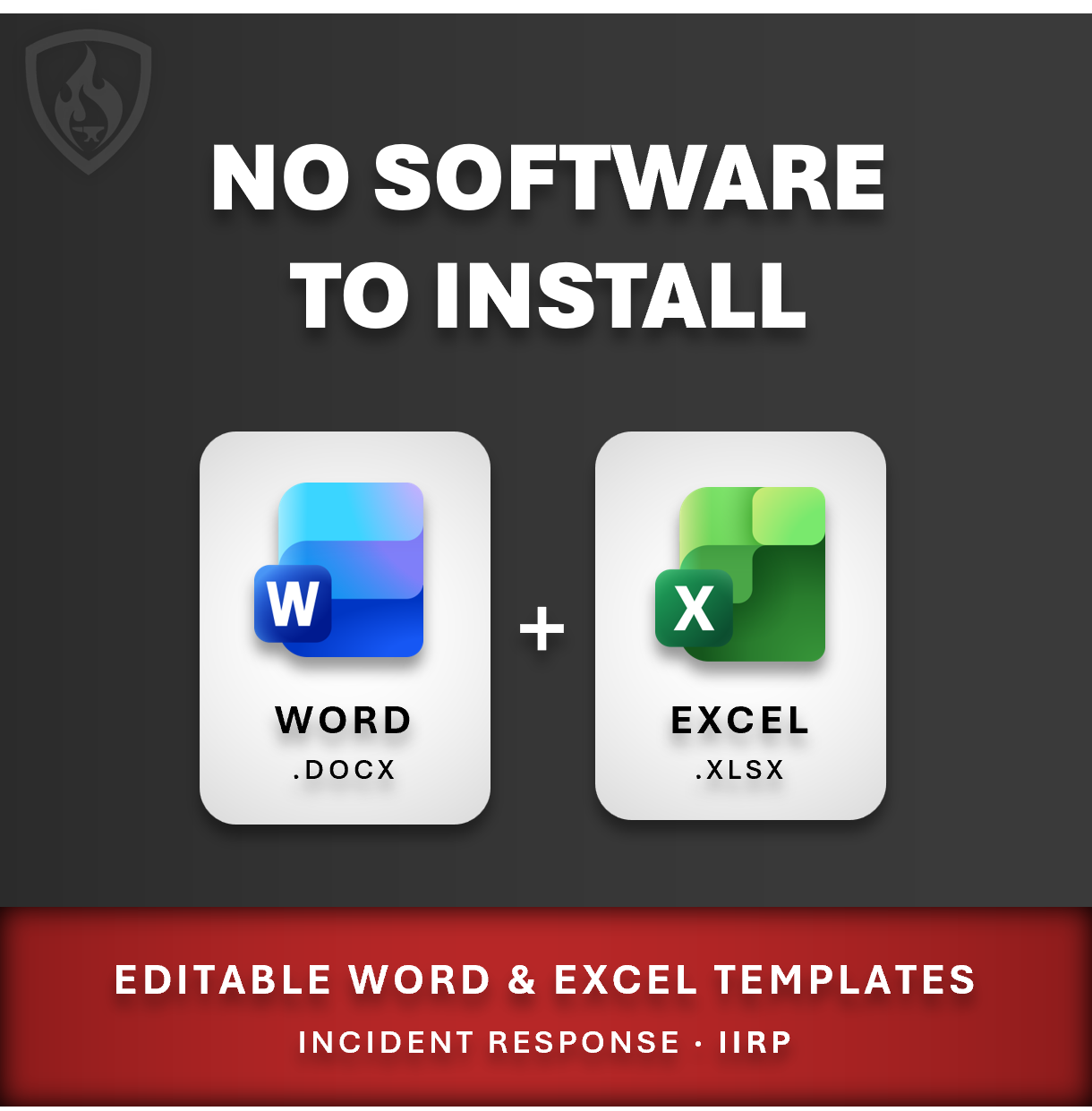
The IIRP is a one-time purchase of editable Microsoft Office documentation templates. There is no software to install, no agent to deploy, no account to provision, and no cloud environment to configure. If the organization can open and edit Microsoft Word, Excel, PowerPoint, and Visio files, the IIRP is ready to use.
Microsoft Office Files
Delivered as fully editable .docx, .xlsx, .pptx, and .vsdx files. Compatible with Microsoft 365, Office 2016 and newer, and most third-party tools. The IIRP includes built-in styles, tables, tabletop exercise decks, and process-flow diagrams that are ready for customization.
Email Delivery
Documentation is delivered via email download link within 1-2 business days of purchase, often the same business day. There is no installer, no license server, and no activation step.
One-Time Purchase
A single-entity license is included with purchase. There is no recurring subscription requirement, although an optional update subscription is available to stay current as frameworks and leading practices evolve.

This deployment model is intentional. Incident response documentation belongs in the organization's own hands, inside its own document management and incident response toolchains, rather than locked inside a vendor's SaaS tool. Once delivered, this product belongs to the buyer.
What Problems Does The IIRP Solve?
Lack of In House Security Experience
Writing security documentation is a skill that many good cybersecurity professionals simple are not proficient at and avoid the task at all cost. Tasking your security analysts and engineers to write comprehensive documentation (e.g., Integrated Incident Response Program documentation) means you are actively taking them away from protecting and defending your network, which is not a wise use of their time. The NIST 800-61-based IIRP is an efficient method to obtain a comprehensive incident response program for your organization!
Compliance Requirements
Nearly every organization, regardless of industry, is required to have formally-documented incident response program. Requirements range from PCI DSS to NIST 800-171 to EU GDPR. The IIRP is designed with compliance in mind, since it focuses on leading security frameworks to address reasonably-expected incident response activities.
Audit Failures
Security documentation does not age gracefully like a fine wine. Outdated documentation leads to gaps that expose organizations to audit failures and system compromises. The IIRP is easy to maintain and customize for your organization, since it is Microsoft Office-based documentation that you can edit for your needs and keep current as things change in your environment.
Vendor Requirements
It is very common for clients and partners to request evidence of an incident response program. The IIRP provides this evidence!
How Does The IIRP Solve These Problems?
The IIRP addresses each incident response challenge with concrete, measurable outcomes. It is designed to take an organization from informal incident handling to a defensible, repeatable response program in weeks rather than months.
Clear Documentation
The IIRP provides comprehensive documentation to prove that your incident response program exists. This equates to a time saving of hundreds of hours and tens of thousands of dollars in staff and consultant expenses
Time Savings
The IIRP can provide your organization with a semi-customized solution that requires minimal resources to fine tune for your organization's specific needs.
Alignment With Leading Practices
The NIST-based IIRP is written to align your organization with leading practices for incident response.
What Is Included?
The IIRP is delivered as editable Microsoft Office documentation. Purchase includes a single-entity license and the first year of product updates. The package contains the program framework, tabletop exercise material, process flows, and framework mapping content.
IIRP Document
Editable Microsoft Word document covering the program-level framework for incident response, including scope, applicability, roles and responsibilities, the ISIRT structure, the eleven incident categories, four severity classifications, response phases, and deliverables expected at each phase.
Supplemental Documentation
In addition to the main IIRP document, you will also receive a RASCI template, IIRP Categories & Scenarios document, multiple PDF reference guides, and scenarios from CISA.
The Cornerstone Of Incident Response
Most cybersecurity documentation describes what incident response policy should require. The IIRP is different: it serves as the cornerstone that operationalizes how incident response is actually conducted. The IIRP fills the middle ground between high-level policies and the tactical Incident Response Plans (IRPs) executed by individual contributors during real incidents, giving the organization the program-level guidance and tabletop training material to respond effectively.
Cost Savings Estimate
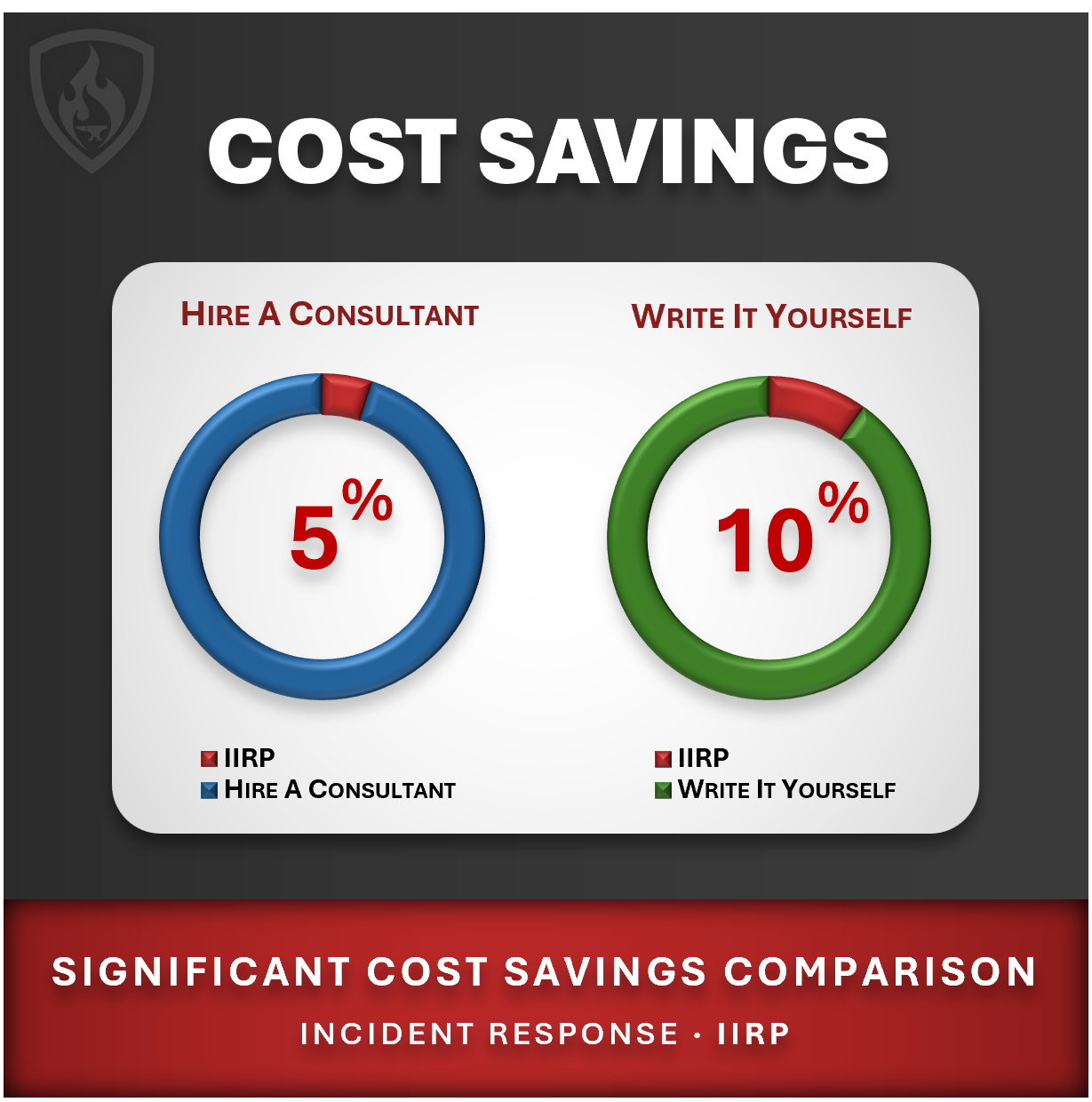
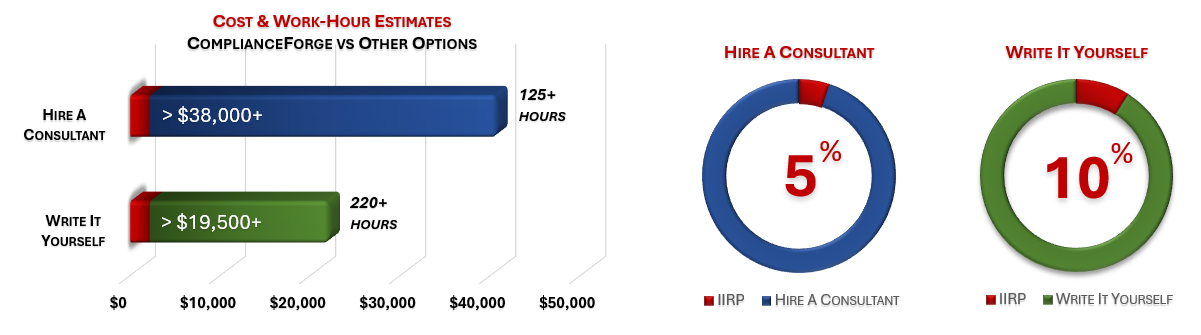
When you look at the costs associated with either (1) hiring an external consultant to write cybersecurity documentation for you or (2) tasking your internal staff to write it, the cost comparisons paint a clear picture that buying from ComplianceForge is the logical option. Compared to hiring a consultant, you can save months of wait time and tens of thousands of dollars. Whereas, compared to writing your own documentation, you can potentially save hundreds of work hours and the associated cost of lost productivity. Purchasing the IIRP from ComplianceForge offers these fundamental advantages when compared to the other options for obtaining quality cybersecurity documentation:
Internal Staff Cost
For your internal staff to generate comparable documentation, it would take them an estimated 220 internal staff work hours, which equates to a cost of approximately $19,500 in staff-related expenses. This is about 3 to 6 months of development time where your senior cybersecurity and incident response staff would be diverted from operational duties.
The IIRP is approximately 10% of the cost for your internal staff to generate equivalent documentation.
External Consultant Cost
If you hire a consultant to generate this documentation, it would take them an estimated 125 consultant work hours, which equates to a cost of approximately $38,000. This is about 2 to 3 months of development time for a contractor to provide you with the deliverable.
The IIRP is approximately 5% of the cost for an external consultant to generate equivalent documentation.
Product Examples
The IIRP addresses program-level guidance on HOW to actually manage incident response operations, including forensics and reporting. Policies & standards are absolutely necessary to an organization, but they fail to describe HOW incident response is actually managed. The IIRP provides this middle ground between high-level policies and the actual procedures of how Incident Response Plans (IRPs) are executed by those individual contributors task with incident response duties. The IIRP comes with a wealth of guidance, including scenario-based guidance, example IRPs, how to identify both Indicators of Exposure (IoE) and Indicators of Compromise (IoC) and more!
Coverage spans strategic program guidance, operational ISIRT structure, and tactical response material, regardless of whether the organization's primary framework is NIST, ISO, SCF, PCI DSS, or another framework.
Below is a PDF example containing a sample of the policies & standards you would receive upon purchasing the IIRP.

How Much Customization Remains?
Given the difficult nature of writing templated incident response documentation, ComplianceForge aims for approximately an 80% solution because it is impossible to write a 100% cookie-cutter document that can be equally applied across every organization. Incident response depends on the specific industry, technology stack, regulatory environment, and existing response toolchain of the organization, so the remaining work is fine-tuning the IIRP with the specific information that only the organization knows.
In practice, customization is filling in the blanks and following the guidance provided to identify the who, what, when, where, why, and how for the specific organization. Typical customization tasks include adding the company name and logo, naming actual ISIRT members and incident response leads, tailoring incident categories and severity thresholds to the organization's risk tolerance, calibrating tabletop scenarios to the most likely incidents, and integrating the IIRP with existing security tooling, communications plans, and legal and PR coordination workflows.

Professional Services
ComplianceForge offers optional professional services to customize purchased documentation. Professional services are not required to customize ComplianceForge documentation. However, some clients want our subject matter expertise to help customize their documentation to meet their specific business needs. We offer the following professional service bundles:
5-Hour Bundle
This includes five (5) hours of professional services, which may be beneficial for companies that need some guidance on getting started with how to tailor their documentation.
10-Hour Bundle
This includes ten (10) hours of professional services, which may be beneficial for companies that need additional guidance on tailoring their documentation to meet their compliance requirements.
20-Hour Bundle
This includes twenty (20) hours of professional services, which may be beneficial for companies that need robust services, beyond just 10 hours, to assist in tailoring their documentation to meet their compliance requirements.
Purchased professional service hours expire 120 days (4 months) from the time of purchase if unused. Hours are intended to supplement, not replace, your own customization work, since only your organization knows the exact details to tailor your documentation. For questions regarding scoping a professional services engagement or configuring a custom package, contact ComplianceForge directly through the Contact Us page.
Why Incident Response Matters
A documented incident response program has become a baseline expectation across regulatory, contractual, insurance, and customer due-diligence contexts. PCI DSS, NIST 800-171, CMMC, HIPAA, GDPR, SOX, NY DFS, SOC 2, and the SEC cybersecurity disclosure rule all require evidence of a formal incident response program with defined response procedures and reporting timelines. Cyber insurance underwriters increasingly require evidence of a documented incident response program as a precondition for coverage. Customer due-diligence reviews routinely ask for incident response documentation as part of vendor onboarding.
Without a documented incident response program, organizations face audit findings, lost contracts, denied insurance claims, regulatory penalties, and the operational reality that the first major incident becomes the moment the response procedures are written, not the moment they are executed. The IIRP provides the program-level documentation that makes incident response demonstrable to auditors, regulators, customers, and insurers, and provides the playbook responders need before the next incident occurs.
NIST 800-61 Based Incident Response Program
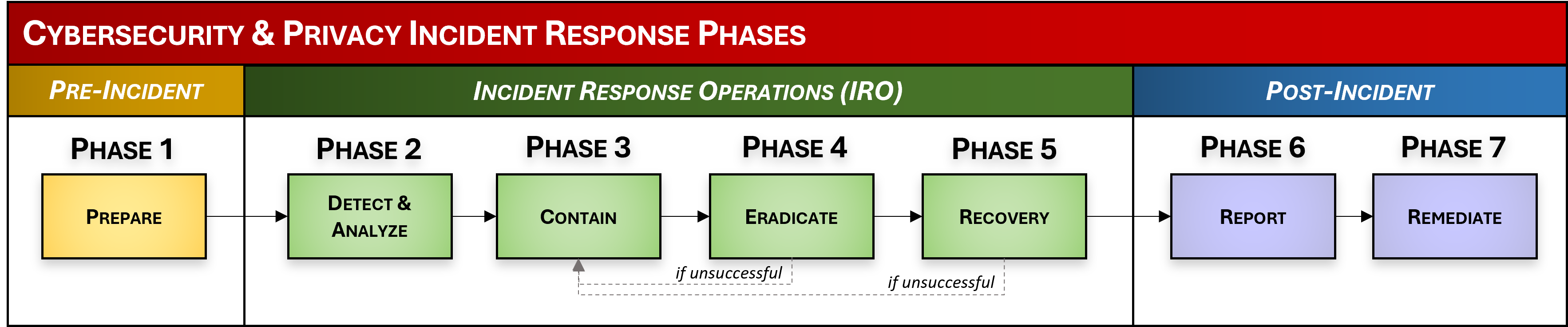
The IIRP operates at the strategic level to provide guidance to your organization's incident responders. It provides the overall framework that governs incident response across the enterprise with a focus on repeatable processes and sustainable operations. The IIRP breaks down the management of incident response into phases:
- Pre-Incident
- Phase 1 - Prepare
- Incident Response Operations
- Phase 2 - Detect & Analyze
- Phase 3 - Contain
- Phase 4 - Eradicate
- Phase 5 - Recovery
- Post Incident
- Phase 6 - Report
- Phase 7 - Remediate!