

- NIST SP 800-161 Rev 1 provides guidance for managing cybersecurity risks throughout the supply chain, from acquisition through disposal.
- C-SCRM is now explicitly required by NIST 800-171 R3. You need not only a plan but operational evidence it works.
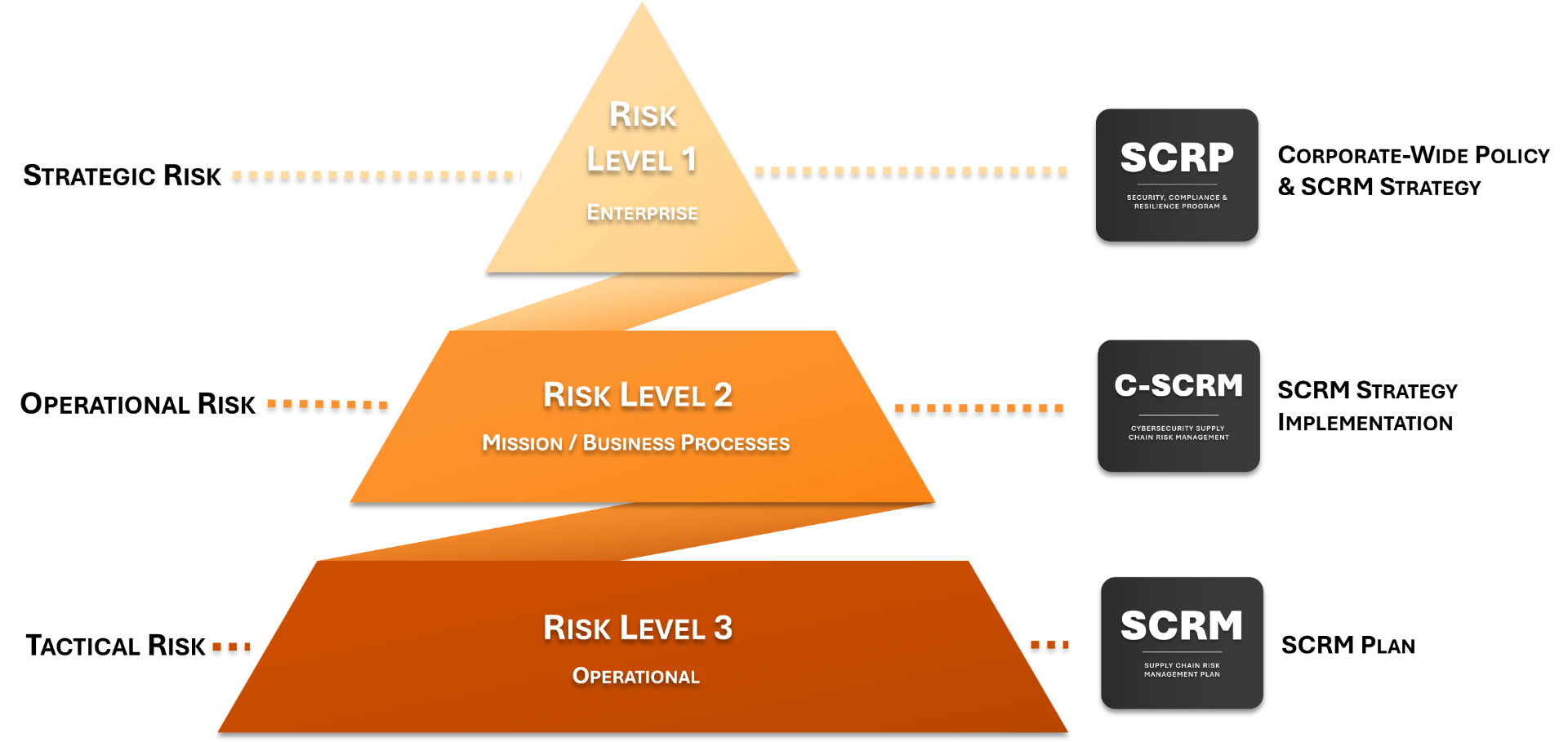
- The framework uses a three-tiered approach: Organization (governance), Mission / Business Process (operations), and Information System (technical).
- Applicable to any organization in the federal supply chain. DoD contractors, IT service providers, manufacturers, and subcontractors.
- ComplianceForge provides an editable C-SCRM Plan template and implementation guidance aligned to NIST 800-161 R1.
What Is NIST SP 800-161 Rev 1?
NIST SP 800-161 Rev 1 refers to the First Revision (Rev 1) of National Institute of Standards and Technology Special Publication 800-161 (NIST SP 800-161):
- Publication Title: Cybersecurity Supply Chain Risk Management Practices for Systems and Organizations
- Published Date: November 2024
NIST SP 800-161 was first published in 2015 and the current version (Rev1) was released in November 2024. This publication provides guidance to organizations on identifying, assessing, and mitigating cybersecurity risks throughout the supply chain at all levels of their organizations.
NIST SP 800-161 Rev 1 integrates Cybersecurity Supply Chain Risk Management (C-SCRM) into risk management activities by applying a multilevel, C-SCRM-specific approach that includes guidance on the development of:
- C-SCRM strategy implementation plans;
- C-SCRM policies;
- C-SCRM plans; and
- Risk assessments for products and services.
NIST SP 800-161 Rev 1 is a foundational cybersecurity guidance document that is designed to help manage cybersecurity risks in an organization’s supply chains, which are increasingly being targeted by sophisticated cyber threats. This publication is the US Government's authoritative playbook for securing the supply chain from cyber threats, including initiatives such as the GSA OASIS+ that requires conformity with NIST 800-161 R1. This C-SCRM framework outlines a risk-based, tiered approach to identifying and mitigating risks associated with third-party products, services and vendors. As supply chain attacks become more prevalent and sophisticated, adopting NIST 800-161 R1 is critical for organizations aiming to build a resilient cybersecurity posture in both government and industry settings.
Why C-SCRM Matters Now
Cybersecurity Supply Chain Risk Management (C-SCRM) is the process of identifying, assessing and mitigating cybersecurity-related risks in an organization's supply chain that could impact the security and integrity of an organization's products, services and operations.
C-SCRM includes risks associated with the use of third-party vendors, software and other components that make up an organization's broader technology infrastructure. Effective C-SCRM involves identifying potential vulnerabilities and threats in the supply chain and implementing measures to reduce or eliminate those risks. This includes conducting risk assessments, implementing cybersecurity controls and regularly monitoring the supply chain for evolving threats and potential vulnerabilities. C-SCRM also involves working closely with suppliers and vendors to ensure that those External Service Providers (ESP) meet an organization's cybersecurity and privacy requirements to prevent the introduction of additional risks to the organization.
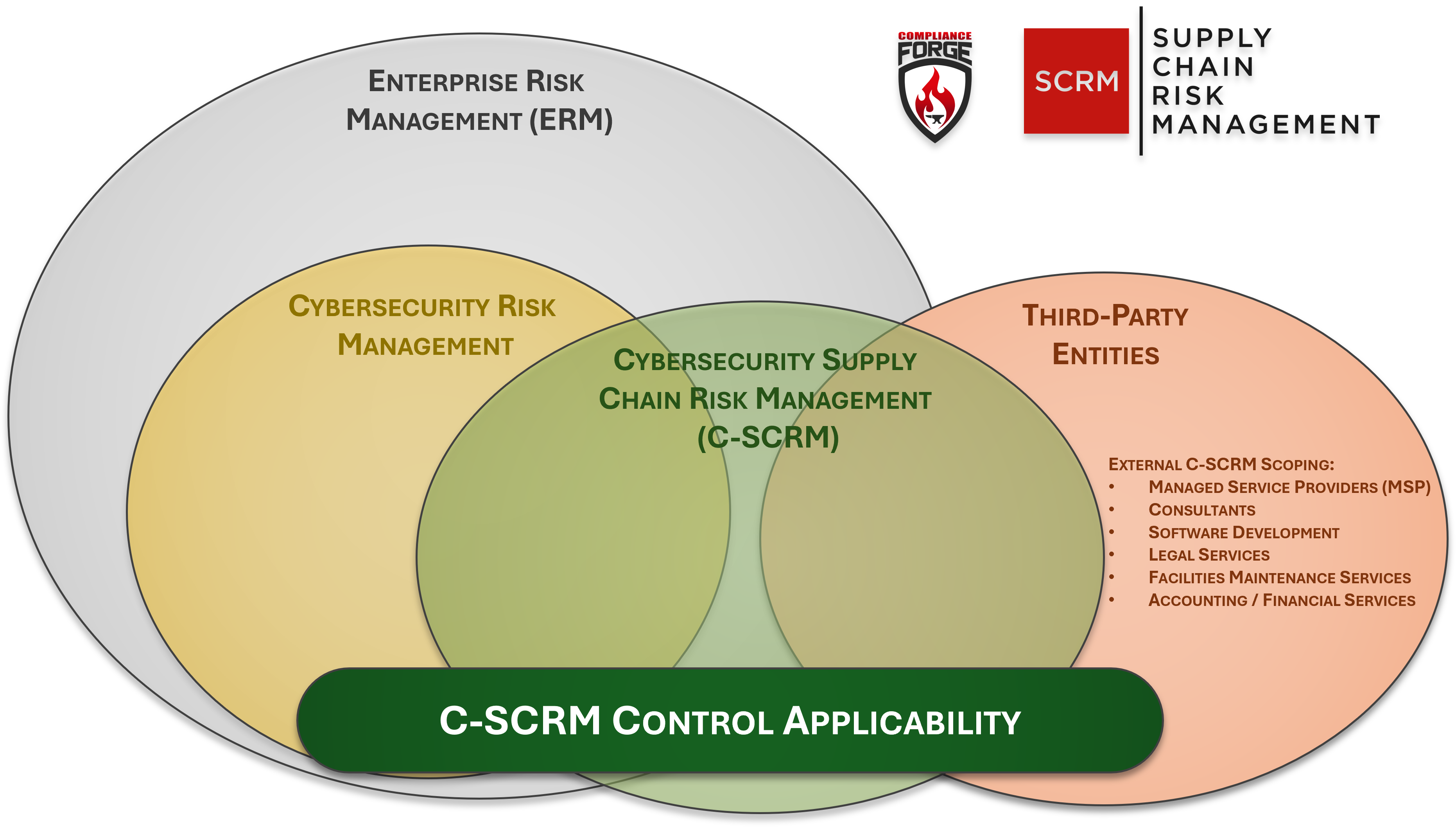
To help visualize the concept of C-SCRM as it fits into an organization:
- Enterprise Risk Managemtn (ERM) is how risk is managed across an organization (common in larger businesses);
- Cybersecurity risk managment is a subset of ERM, since it is focused on a portion of what ERM addresses;
- C-SCRM is a subset of ERM, due to the stakeholders that exist outside of the cybersecurity department;
- C-SCRM is also a subset of cybersecurity risk management, since it is focused on a portion of what cybersecurity risk management addresses;
- C-SCRM also has flow-down ramifications on third-party entities due to contractual obligations that they must address. One organization's C-SCRM requirements will impact the internal operations of its supply chain partners, based on the contractual requirements that are flowed down and have to be complied with.
According to NIST SP 800-161 Rev 1, C-SCRM involves identifying, assessing and mitigating the risks associated with the acquisition and use of products and services within an organization's supply chain. These risks can arise from a wide range of sources, including:
- Malicious actors;
- Lackadasical supplier practices;
- Counterfeit components; and
- Vulnerabilities introduced through software, hardware and/or third-party services.
What Is The Purpose of Cybersecurity Supply Chain Risk Managment (C-SCRM) Compliance?
The primary purpose of NIST SP 800-161 is to provide guidance on integrating Cybersecurity Supply Chain Risk Management (C-SCRM) into organizational risk management practices. NIST 800-161 R1:
- Aligns with Executive Order 14028 on improving the nation’s cybersecurity;
- Complements existing cybersecurity frameworks such as NIST 800-53 (cybersecurity and data privacy controls); and
- Aligns with the NIST Cybersecurity Framework (NIST CSF).
NIST 800-161 recognizes that supply chains are global, complex and dynamic, often involving multiple tiers of suppliers. As such, the publication outlines a comprehensive and strategic approach for identifying, assessing and mitigating supply chain-related risks to systems and data.
Key elements from NIST 800-161 R1 include:
- Integration of C-SCRM into Enterprise Risk Management (ERM) processes;
- Establishment of governance structures for managing supply chain risks;
- Development of policies, procedures and controls tailored to supply chain concerns; and
- Assessment and monitoring of suppliers, components and processes throughout the system lifecycle.
Key elements from NIST 800-161 R1 include:
US Government Contract Requirements For NIST SP 800-161 R1
The General Services Administration (GSA) currently has contract requirements for NIST 800-161 R1. As part of GSA OASIS+ J-3 post-deliverables, a contractor is expected to be able to minimally demonstrate the following:
- A cybersecurity program based on NIST SP 800-171 R2 controls (e.g., policies, standards, procedures and evidence of implementation);
- A Cybersecurity Supply Chain Risk Management (C-SCRM) plan based on NIST SP 800-161 R1;
- Cybersecurity incident response capability; and
- Business continuity / disaster recovery (BC/DR) practices.

Who Needs To Comply With NIST SP 800-161 Rev 1?
There are two (2) key drivers for NIST SP 800-161 Rev 1 compliance:
- NIST SP 800-171 Rev 3 contains requirements for C-SCRM in section 3.17; and
- The US General Services Administration (GSA) is including requirements for NIST SP 800-161 Rev 1 compliance in GSA contracts.
While these drivers are the US Government, the C-SCRM nature of NIST SP 800-161 Rev 1 will trickle down across all industries and organization sizes. Examples of organizations that will be caught in trickle down contact requirements for C-SCRM include, but are not limited to:
What Are the Penalties For Non-Compliance With NIST SP 800-161 Rev 1?
Compliance with NIST SP 800-161 Rev 1 is not entirely the responsibility of an organization’s cybersecurity department, since it entails a multifaceted approach that requires significant involvement from these key functions:
- Cybersecurity;
- Enterprise Risk Management (ERM); and
- Contracts management.
Currently, compliance with NIST SP 800-161 Rev 1 is “on the honor system” similar to compliance with HIPAA, PCI DSS, GDPR and other common compliance obligations that organizations must comply with. could be a False Claims Act (FCA) violation and the US Department of Justice (DOJ) is taking FCA violations seriously. Additional penalties for non-compliance with NIST 800-171 Rev 2 include, but are not limited to:
As you can see from those examples, the cost of non-compliance is quite significant. As always, seek competent legal counsel for any pertinent questions on your specific compliance obligations.
How Can I Comply With NIST 800-161 Rev 1?
The term "supply chain security" broadly refers to the measures taken to protect the integrity and reliability of the goods and services that make up an organization's supply chain, which includes suppliers, partners, consultants and other vendors that provide goods or services to that organization. The goal of supply chain security is to ensure that those obtained goods and services are of the highest quality, are free from tampering and were delivered to the intended recipients (e.g., man in the middle supply chain attack). There are several aspects to supply chain security that include, but are not limited to:
Ensuring the security of the supply chain is important for the integrity and reliability of goods and services, as well as for the reputation of those organizations involved in the supply chain. The encompassing terminology used to define this broad practice is Supply Chain Risk Management (SCRM). There are many steps involved in complying with NIST SP 800-161. For most organizations, the process of complying with NIST SP 800-171 Rev 1 is likely a multi-year endeavor. This estimate is based on a few factors:
- While C-SCRM contains “cybersecurity” in its name, C-SCRM exists beyond just the cybersecurity department.
- C-SCRM entails a multifaceted approach that requires significant involvement from these non-cybersecurity functions that will require the organization’s executive leadership to ensure involvement:
- Information Technology (IT);
- Enterprise Risk Management (ERM); and
- Procurement / contracts management.
Practical guidance associated with implementing NIST SP 800-161 Rev 1 practices includes the following steps:
- Structure C-SCRM roles & responsibilities for success;
- Establish and document C-SCRM policies, standards and procedures;
- Integrate C-SCRM into Enterprise Risk Management (ERM);
- Define and apply controls to supply chain activities;
- Identify and assess supply chain elements, including suppliers and External Service Providers (ESP);
- Monitor, identify and respond to supply chain threats and risks; and
- Maintain robust stakeholder engagement across the organization.
NIST SP 800-161 Step 1: Structure C-SCRM Roles & Responsibilities For Success
There is an adage that “If you fail to plan, you plan to fail” and C-SCRM is no exception, where failing to structure the stakeholders upfront is essentially guaranteeing failure. All the recommended practices in NIST SP 800-161 Rev 1 are moot if an organization tries to operate C-SCRM in siloes or if C-SCRM is viewed as a cybersecurity problem. This step involves:
- Analyzing the organization’s business operations to find the most effective role to have ownership for C-SCRM.
- Designate the role of Chief Supply Chain Officer (CSCO) to an individual with oversight of:
- Systems applications and services management (e.g., IT);
- Procurement practices (e.g., contracts management);
- Secure development practices (e.g., DevOps);
- Risk management practices (e.g., ERM); and
- Cybersecurity and data protection controls (e.g., cybersecurity).
Note
Based on NIST SP 800-161 Rev 1 guidance, the role of the Chief Operations Officer (COO) might be the most appropriate role to be elevated to, or assigned the additional mantle, of CSCO.
NIST SP 800-161 Step 2: Establish and Document C-SCRM Policies, Standards and Procedures
With the organization structure in place to ensure practices fall under the CSCO/COO, it is necessary to revise the organization’s policies, standards and procedures to account for C-SCRM practices to address how supply chain risks are identified, assessed and managed. This process of updating policies, standards and procedures to address C-SCRM includes:
- Developing criteria and supporting processes to evaluate and select suppliers and External Service Providers (ESP);
- Update processes to include C-SCRM in secure development, production and delivery operations.
- Transform incident response protocols to focus on resiliency from supply chain disruptions or compromises.
NIST SP 800-161 Step 3: Integrate C-SCRM into Enterprise Risk Management (ERM)
The single biggest prerequisite to implementing NIST SP 800-161 Rev 1 is organization-wide risk management practices, which are generally referred to as Enterprise Risk Management (ERM). ERM is not a tool, but a capability to manage risks across the organization (e.g., risks from technical, operational, financial, legal, etc. sources). The reason ERM is considered a prerequisite for NIST SP 800-161 Rev 1 is the need to embed supply chain risk considerations into existing risk management processes.
NIST SP 800-161 Rev 1 emphasizes that C-SCRM is not a standalone activity, since it builds upon concepts described in a number of NIST and other publications:
- Cybersecurity controls from NIST SP 800-53 Rev 5 (C-SCRM controls);
- Risk management framework structure from NIST SP 800-37 Rev 2;
- Multilevel risk management approach from NIST SP 800-39; and
- Impact categorization approach from Federal Information Processing Standards (FIPS) Publication 199 (FIPS 199).
NIST SP 800-161 Rev 1 emphasizes that C-SCRM is not a standalone activity, since it builds upon concepts described in a number of NIST and other publications:
This process of elevating C-SCRM into an enterprise view of risk management with ERM includes:
- Ensuring C-SCRM is included in strategic planning and governance processes;
- Defining C-SCRM objectives aligned with organizational risk tolerance; and
- Standardizing organization-wide risk management criteria for C-SCRM.
NIST SP 800-161 Step 4: Define and Apply Controls to Supply Chain Activities
From the previous steps to implement necessary fundamental governance practices associated with C-SCRM, an organization can then apply appropriate cybersecurity and data protection controls to address its unique supply chain risks and threats.
Available sources of C-SCRM controls include:
Available sources of C-SCRM controls include:
- Contractual obligations (including flow down requirements) for C-SCRM practices;
- Management approval, based on risk assessment results, prior to contracting with a third-party;
- Protecting against counterfeit components; and
- Requiring Secure Software Development Practices (SSDP).
Once the C-SCRM controls are defined, the underlying governance practices defined in the previous steps are what help implement the C-SCRM controls with the organization’s supply chain.
NIST SP 800-161 Step 5: Identify and Assess Supply Chain Elements, Including Suppliers and External Service Providers (ESP)
This step focuses on establishing situational awareness of the organization’s supply chain, starting with inventorying supply chain elements that include suppliers and External Service Providers (ESP). With an accurate inventory of supply chain elements, that enables the organization to conduct thorough due diligence on suppliers, vendors and other third parties.
To accomplish this step, organizations should:
- Develop and maintain an updated inventory of suppliers and critical components;
- Evaluate supplier cybersecurity practices and risk posture; and
- Validate contractual requirements for cybersecurity, transparency and reporting exist with each supplier.
NIST SP 800-161 Step 6: Monitor, Identify and Respond to Supply Chain Threats and Risks
C-SCRM is a continuous process that is expected to evolve, since
- Applicable threats and risks evolve;
- Technologies change;
- Suppliers change; and
- Organizations reorganize so business practices change.
Due to this constant change that affects C-SCRM, organizations are expected to:
- Applicable threats and risks evolve;Maintain the capability to monitor suppliers and third parties for emerging threats or non-compliance;
- Actively participate in threat information sharing (e.g., industry groups or government programs like InfraGard National Members Alliance; and
- Establish mechanisms for reporting and addressing supply chain incidents.
NIST 800-161 advocates for a tiered approach to C-SCRM, integrating risk management at various management levels to make risk management decisions decentralized, when appropriate:
NIST SP 800-161 Step 7: Maintain Robust Stakeholder Engagement Across The Organization
As previously stated, C-SCRM is a multifaceted approach and a successful C-SCRM capability requires collaboration across the organization, including:
- Executive Leadership to provide governance and resources for C-SCRM efforts;
- Procurement to embed C-SCRM requirements into contracts;
- Legal to review agreements for C-SCRM clauses;
- IT to implement technology-related C-SCRM controls; and
- Cybersecurity to conduct technical assessments to validate C-SCRM controls exist and operate as intended.
Practical Steps To Becoming Compliance With NIST SP 800-161 Rev 1 Compliant
For organizations subject to US Government contracting requirements or those operating in critical infrastructure sectors, aligning with NIST SP 800-161 Rev 1 is not just recommended, but is essential for building a resilient and secure supply chain.
Complying with NIST SP 800-161 Revision 1 requires a comprehensive, proactive approach to managing supply chain cybersecurity risks. By embedding C-SCRM into ERM, establishing robust policies, evaluating suppliers, applying security controls and continuously monitoring the supply chain, organizations can better protect their operations from evolving cyber threats.
Frequently-Asked Questions
Here are answers to common questions about NIST SP 800-161: