A well written, good quality information security policy template is singularly focused on policy statements. It is a coordinated set of policies, control objectives, standards and procedures that you can edit, map to the frameworks you must meet, and load into the GRC platform you already use. If a template gives you policy statements without standards or procedures, you will write the rest yourself.
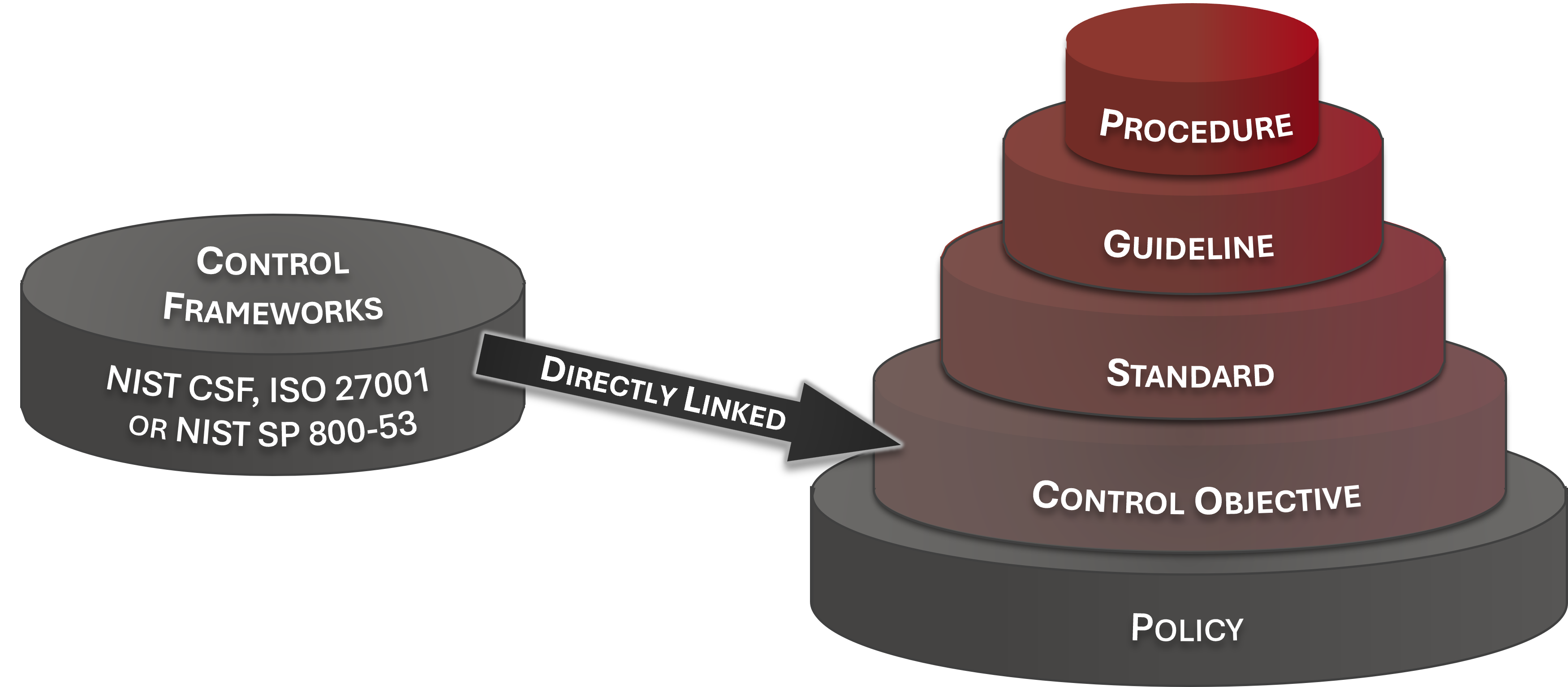
Start by checking what you would actually receive. A complete set should cover these layers, which follow ComplianceForge’s Hierarchical Cybersecurity Governance Framework:
This concept of building hierarchical cybersecurity documentation can be visualized in the graphic shown below for how policies form the basis of all other documentation:
Most organizations answer to more than one framework. A defense contractor may need NIST SP 800-171 and CMMC, a SaaS company may need SOC 2 and ISO 27001, and a company selling into Europe may also face NIS2. Buying one template per framework creates duplicate policies that drift apart.
A document set written to the Secure Controls Framework (SCF) avoids that. ComplianceForge states that the SCF maps to over 200 cybersecurity and data privacy laws, regulations and frameworks [VERIFY: current count on securecontrolsframework.com], so one set of policies and standards can be traced to many requirements. You maintain one document, update it once, and show each assessor the mapping they care about.
GRC platforms track controls, evidence and tasks well, but the policy content inside them still has to be written by someone. ComplianceForge’s premium GRC content is built to support importability into GRC platforms, since these expert-written, editable SCF-based policies, standards, procedures and metrics in Word and Excel and are designed to be imported into a GRC platform.
Ask each security template provider the same questions, and compare the answers side-by-side.
If you need a full-stack documentation rather than individual documents, ComplianceForge’s Security, Compliance & Resilience Program (SCRP) policies and standards provide the SCF-based foundation, and the full range of editable policy and standard templates covers framework-specific options such as NIST 800-53, NIST CSF 2.0 and ISO 27001.
It is an editable starting point for your organization’s information security policies. The most useful templates also include the standards, procedures and control mapping needed to put the policies into practice
Rarely. Most organizations need a policy for each security domain, supported by standards with measurable requirements and procedures for the people doing the work.
Yes, if the policies are mapped to both. A document set written to the Secure Controls Framework can be traced to ISO 27001, SOC 2 and many other frameworks from one source.
No. Editable templates work as standalone documents. A GRC platform helps you track ownership, reviews and evidence, and well-structured templates can be imported into one.