Short answer: Before loading policies into a Governance, Risk & Compliance (GRC) platform, confirm the content is expert-written, editable, follows a clear hierarchy from policy to procedure, maps to a common control set such as the Secure Controls Framework (SCF), covers all of your frameworks in one set, and is kept updated. A GRC platform organizes content; it does not make weak content strong.
Most organizations buy a GRC platform to track controls, evidence and risk across several frameworks. The platform is only as useful as the policies, standards and procedures loaded into it. If the documentation is generic, duplicated per framework, or disconnected from the controls the platform tracks, the platform simply automates the confusion.
A GRC platform links documents to controls, controls to evidence and evidence to auditors. Every weak link becomes visible. If a policy statement cannot be traced to a specific control, an assessor will ask what it is for. If three framework-specific policies say slightly different things about the same topic, your control owners will not know which one to follow. Quality content shortens the time between loading the platform and getting real use from it.
The Hierarchical Cybersecurity Governance Framework (HCGF), or the ComplianceForge Reference Model, provides an excellent visualization for how documentation is meant to be structured and this is key for determining importability into a GRC platform. If documentation lacks this type of structure, it will likely be poorly suited for use in a modern GRC platform.
The Hierarchical Cybersecurity Governance Framework separates documentation into layers so each one has a job:
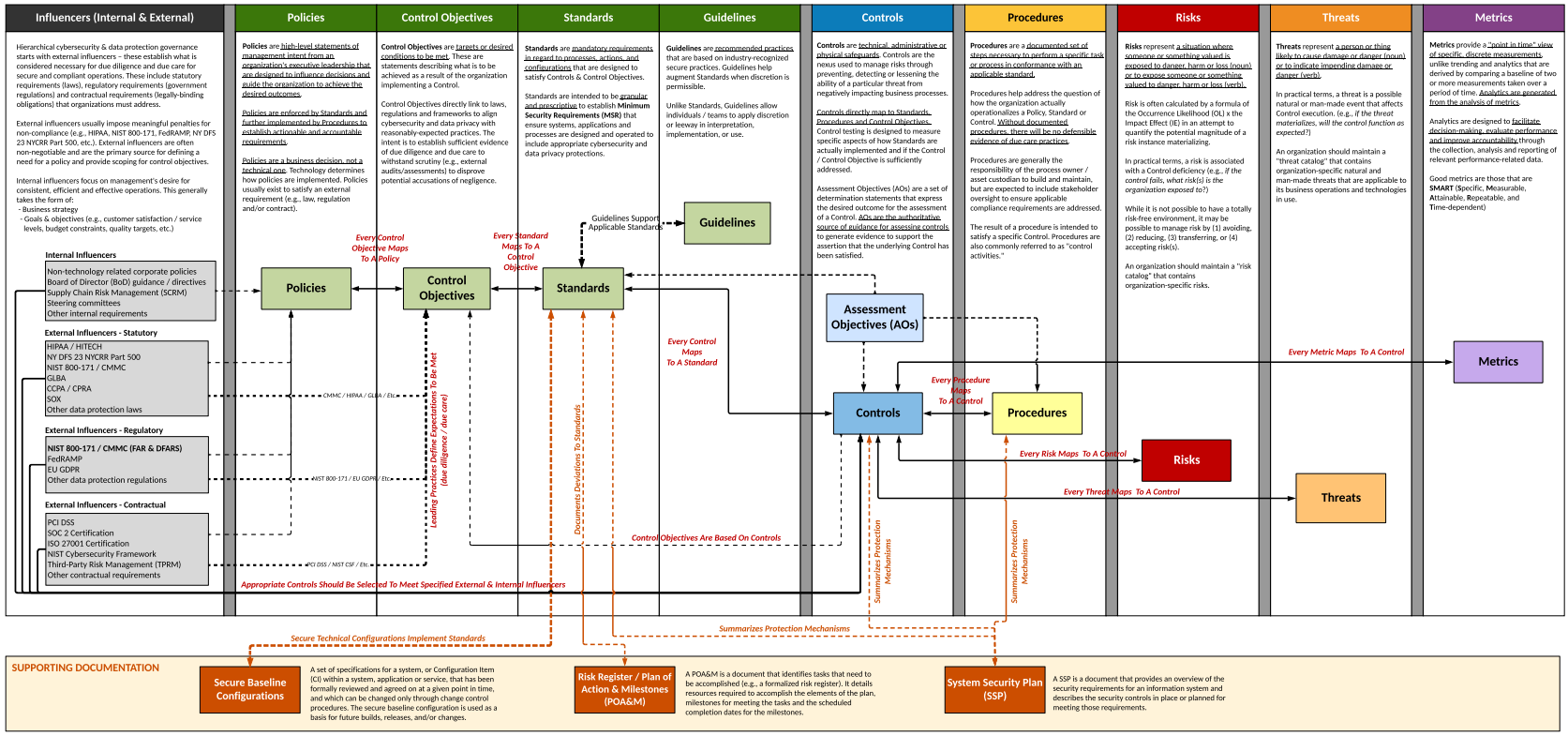
In a GRC platform, policies and standards typically become the policy library, control objectives and standards align to the control register, procedures support control owners and evidence tasks, and metrics feed reporting. When content arrives already structured this way, the import becomes a mapping exercise rather than a rewrite. For a plain-language breakdown of each layer, see Policies vs Standards vs Controls vs Procedures.
No. Free GRC content is not worthwhile if your goal is to be secure, compliant and resilient. While it may provide a starting point, it is often more difficult to edit the "free GRC content" than it is to start from scratch to address an organization's unique business practices. This goes back to the old adage of "you get what you pay for" with free content, where it is often significantly more expensive from a cost of labor perspective to make it work.
The Secure Controls Framework is a metaframework that maps its controls to more than 200 laws, regulations and frameworks. When your policies and standards map to SCF controls, the crosswalk work is already done: a single standard can satisfy the matching requirement in each framework your platform tracks. ComplianceForge is an SCF Licensed Content Provider, and its SCF-based Security, Compliance & Resilience Program (SCRP) is built with a 1-to-1 mapping to the SCF.
ComplianceForge's premium GRC content packages SCF-aligned policies, standards, procedures, guidelines, metrics, controls and capability maturity criteria that are designed to be imported into a GRC platform. SCF Bundle 1 pairs the SCRP policies and standards with the matching procedures, so the policy layer and the procedure layer stay aligned.
The free content that often comes with GRC platform subscriptions often is incomplete and insufficient for unique compliance obligations, such as not providing coverage down to the Assessment Objective (AO) level for NIST SP 800-171 that is a requirement to demonstrate conformity.
You can, but evaluate them against the same checks: hierarchy, editability, control mapping, multi-framework coverage and maintenance. Use whichever content meets those criteria for your obligations.
No. A single SCF-mapped document set can address many frameworks at once, which avoids conflicting duplicate policies and reduces maintenance.
Excel, JSON or CSV formats are optimal for importing editable policies, standards, procedures and other content into a GRC platform. This provides the most flexibility to tailor content and map it to platform fields.
No different than any other documentation, where it should be reviewed at least annually and whenever a framework you follow changes. Content from a reputable content provider that issues updates makes that process more efficient, since the errata and updates can provide a starting point for risk management decisions to edit an organization's documentation.