- NIST SP 800-171 Rev 3 was released 14 May 2024 with significant changes from Rev 2. OMB Circular A-130 requires adoption within one (1) year of publication. That means NIST 800-171 R2 was deprecated on 13 May 2025.
- At the Assessment Objective (AO) level, about 1/3 require minimal effort, about 1/5 require moderate effort, and about 1/2 require significant effort.
- CUI controls dropped from 110 to 97, but discrete requirements increased 260% (from 110 to 287). AOs increased 59% (320 to 510).
- The heaviest lifts are migrating NFO controls into CUI controls (more governance practices) and implementing a Supply Chain Risk Management (SCRM) Plan with operational evidence.
- ComplianceForge provides a 22-phase prioritized implementation plan based on the NIST 800-171 R3 Kill Chain that frontloads governance processes.
What Changed Between Rev 2 and Rev 3?
At the Assessment Objective (AO), when you look at the differences between NIST 800-171 Rev 2 and NIST 800-171 Rev 3 you will find:
Minimal Effort
Approximately one-third (1/3) of the NIST 800-171 Rev 3 AOs should require minimal effort, due to clear and direct mapping to NIST 800-171 Rev 2 AOs.
Moderate Effort
Approximately one-fifth (1/5) of the NIST 800-171 Rev 3 AOs will require a moderate effort, due to indirect mapping to NIST 800-171 Rev 2 AOs.
Significant Effort
Approximately half (1/2) of the NIST 800-171 Rev 3 AOs will require a significant effort, due to either (1) no clear mapping to NIST 800-171 Rev 2 AOs or (2) the AOs are new to NIST 800-171 Rev 3.
The heaviest lift items include the migration of Non-Federal Organization (NFO) controls into CUI controls, which increases the governance practices organizations must address, and not only developing a Supply Chain Risk Management (SCRM) Plan, but implementing C-SCRM practices with operational evidence of due diligence and due care.
NIST 800-171 Rev 3 By the Numbers
Understanding the scale of the transition requires examining both the control counts and the underlying assessment objectives.
Assessment Objectives
While there is an 11% drop in CUI control count (110 to 97), the actual number of discrete requirements under those controls jumped to 287, a 260% increase. Additionally, all 61 NFO controls were absorbed into the CUI requirement set in Rev 3.
Prioritized Steps To Implement NIST SP 800-171 Rev 3
Based on the NIST 800-171 R3 Kill Chain, there are twenty-two (22) prioritized phases an organization should take to implement NIST 800-171 Rev 3. It is important to note that this transition plan to NIST 800-171 Rev 3 frontloads a lot of cybersecurity governance processes, since those governance practices will help prevent controls from being reworked:
ESTABLISH CONTEXT FOR CYBERSECURITY & DATA PROTECTION
This phase has four (4) sub-components:
- Define the organization's applicable statutory, regulatory and contractual obligations for cybersecurity and data protection (e.g., DFARS, FAR, ITAR, etc.).
- Define what Controlled Unclassified Information (CUI) and/or Federal Contract Information (FCI) is for your specific business case (based on the contract).
- Identify the necessary People, Processes, Technology, Data & Facilities (PPTDF) that are necessary and appropriately sized.
- Develop & implement a resource plan (e.g., business plan, budget, road map, etc.) to meet the organization's unique compliance obligations.
IMPLEMENT GOVERNANCE PRACTICES
This phase has two (2) sub-components:
- Develop, implement and maintain policies and standards to address applicable statutory, regulatory and contractual obligations.
- Prioritize objectives from the resource plan for People, Processes, Technology, Data & Facilities (PPTDF) requirements.
ESTABLISH THE COMPLIANCE SCOPE
This phase has five (5) sub-components:
- Create a Data Flow Diagram (DFD) that shows how CUI flows from the DoD all the way down to subcontractors.
- Create and maintain a detailed asset inventory for all systems, applications and services for both in-scope and out-of-scope assets.
- Create a detailed network diagram that includes where CUI is stored, transmitted and/or processed.
- Inventory External Service Providers (ESP) to determine ESP access to CUI and/or in-scope systems, applications and/or services.
- Define roles and responsibilities for internal and external systems, applications and services.
RISK MANAGEMENT PRACTICES
This phase has five (5) sub-components:
- Develop & implement an organization-wide Risk Management Program (RMP) to identify, assess and remediate risk. POA&M deficiencies to prioritize, resource and remediate.
- Document and maintain a Cybersecurity Supply Chain Risk Management (C-SCRM) Plan that is specific to the CUI environment.
- Develop and implement acquisition strategies, contract tools, and procurement methods to operationalize the C-SCRM Plan
- Enforce C-SCRM requirements across the supply chain.
- Establish a process for identifying and addressing weaknesses or deficiencies in the supply chain elements and processes.
DOCUMENT THE CUI AND/OR FCI ENVIRONMENT
This phase has three (3) sub-components:
- Start populating the System Security Plan (SSP). POA&M deficiencies to prioritize, resource and remediate.
- Create and maintain a Plan of Action & Milestone (POA&M) to track and remediate deficiencies.
- Perform a gap assessment from applicable statutory, regulatory and contractual obligations. POA&M deficiencies to prioritize, resource and remediate.
IDENTIFY COMPLIANCE STAKEHOLDERS
This has two subcomponent steps:
- Identify compliance stakeholders (including control owners and control operators) and formally assign those individuals roles and responsibilities. From a governance perspective, this can be simplified in a Responsible, Accountable, Supporting, Consulted and Informed (RASCI) matrix.
- Work with Human Resources (HR) to ensure personnel security requirements are integrated into HR operations. POA&M deficiencies to prioritize, resource and remediate.
- Define and implement processes to securely handle CUI wherever CUI is stored, processed and/or transmitted
- Ensure control owners / operators develop, implement and maintain procedures to operationalize the organization's policies & standards.
- POA&M deficiencies to prioritize, resource and remediate.
DATA PROTECTION PRACTICES
This involves developing and implementing data protection practices to limit logical and physical access to CUI and/or FCI. POA&M deficiencies to prioritize, resource and remediate.
SEGMENTED NETWORK ARCHITECTURE
This involves implementing a network architecture that ensures it is built on secure engineering principles and enclaves to protect sensitive information (e.g., FCI/CUI). POA&M deficiencies to prioritize, resource and remediate.
CHANGE MANAGEMENT (CM)
This involves developing and implementing Change Management (CM) practices, including a Change Control Board (CCB). POA&M deficiencies to prioritize, resource and remediate.
INCIDENT RESPONSE (IR)
This involves developing and implementing Incident Response (IR) capabilities to detect, respond and recover from incidents (e.g., Incident Response Plan (IRP)). POA&M deficiencies to prioritize, resource and remediate.
SITUATIONAL AWARENESS (SA)
This involves developing and implementing Situational Awareness (SA) capabilities through threat intelligence, log collection and analysis (e.g., SIEM, XDR, etc.). POA&M deficiencies to prioritize, resource and remediate.
SECURE BASELINE CONFIGURATIONS (SBC)
This involves developing and implementing Secure Baseline Configurations (SBC) (e.g., hardening standards) for all technology platforms (e.g., servers, workstations, network gear, applications, databases, etc.). POA&M deficiencies to prioritize, resource and remediate.
IDENTITY & ACCESS MANAGEMENT (IAM)
This involves developing and implementing Identity & Access Management (IAM) capabilities to address "least privilege" and Role-Based Access Control (RBAC). POA&M deficiencies to prioritize, resource and remediate.
PROACTIVE MAINTENANCE
This involves developing and implementing proactive maintenance practices. POA&M deficiencies to prioritize, resource and remediate.
ATTACK SURFACE MANAGEMENT (ASM)
This involves developing and implementing Attack Surface Management (ASM) practices to identify and remediate vulnerabilities. POA&M deficiencies to prioritize, resource and remediate.
IT ASSET MANAGEMENT (ITAM)
This involves developing and implementing IT Technology Asset Management (ITAM) practices. POA&M deficiencies to prioritize, resource and remediate.
LAYERED NETWORK DEFENSES
This involves developing and implementing layered network security for Defense-in-Depth (DiD) practices. POA&M deficiencies to prioritize, resource and remediate.
BUSINESS CONTINUITY & DISASTER RECOVERY (BC/DR)
This involves developing and implementing Business Continuity / Disaster Recovery (BC/DR) capabilities. POA&M deficiencies to prioritize, resource and remediate.
CRYPTOGRAPHIC KEY MANAGEMENT
This involves developing and implementing cryptographic key management and data encryption capabilities. POA&M deficiencies to prioritize, resource and remediate.
PHYSICAL SECURITY
This involves developing and implementing physical security practices. POA&M deficiencies & document procedures.
SECURITY AWARENESS TRAINING
This involves developing and implementing training & awareness to ensure a security-minded workforce. POA&M deficiencies & document procedures. POA&M deficiencies to prioritize, resource and remediate.
INTERNAL AUDIT (IA)
This involves developing and implementing an "internal audit" or Information Assurance (IA) capability to govern controls. POA&M deficiencies & document procedures. POA&M deficiencies to prioritize, resource and remediate.
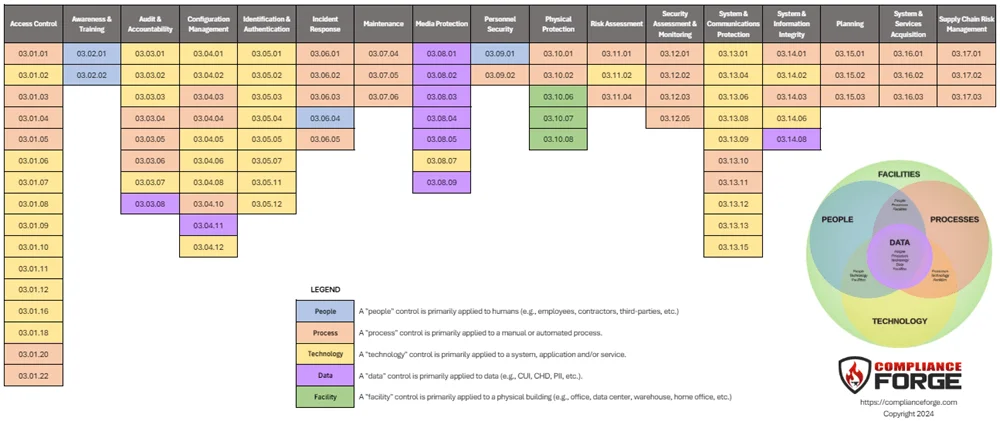
NIST 800-171 R3 Controls by Type - Does It Affect People, Processes, Technologies, Data or Facilities (PPTDF)?
Understanding whether a control is primarily about people, process, technology, data or facilities helps visualize the breadth of requirements.
People
A "people" control is primarily applied to humans (e.g., employees, contractors, third-parties, etc.).
Process
A "process" control is primarily applied to a manual or automated process.
Technology
A "technology" control is primarily applied to a system, application and/or service.
Data
A "data" control is primarily applied to data (e.g., CUI, CHD, PII, etc.).
Facility
A "facility" control is primarily applied to a physical building (e.g., office, data center, warehouse, home office, etc.).
Is There A NIST 800-171 R3 "Easy Button"?
No. While there is no "easy button" for NIST 800-171 R3, ComplianceForge has made the upgrade path less painful with the NIST 800-171 Compliance Program (NCP).
