


ComplianceForge is a Licensed Content Provider (LCP) for the Secure Controls Framework (SCF) and created a Responsible, Accountable, Supporting, Consulted and Informed (RASCI) matrix that addresses all 1,400+ SCF controls. This RASCI format leverages the NIST NICE Cybersecurity Workforce Framework as the foundation for the work roles and work role IDs.
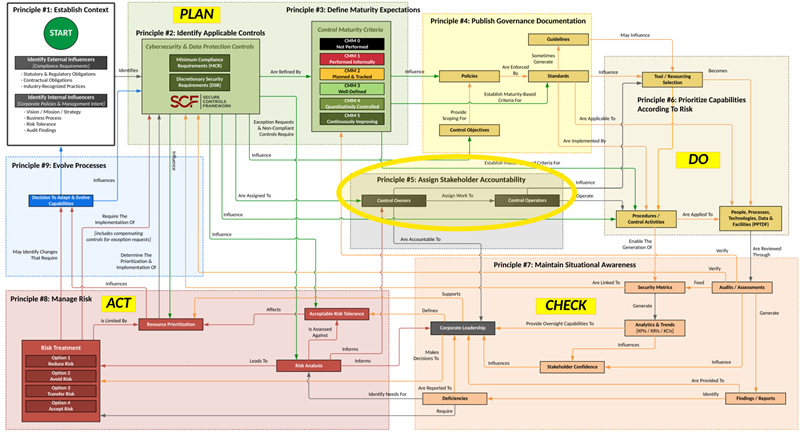
Principle #5 of the SCF's Security, Compliance & Resilience Management System (SCRMS) is focused on assigning stakeholder accountability. That is arguably one of the most difficult principles to put into practice, due to the incomplete picture of stakeholders and a lack of a viable RASCI to make those assignments. This SCF-based RASCI makes Principle #5 a straightforward exercise by simply mapping existing people in your organization to those identified roles in the RASCI.
The Leadership Value of a Clearly-Defined RASCI Matrix
If a control has no clear operational owner, the risk does not disappear - it merely escalates. In practice, that means executive leadership may be accepting cybersecurity, data privacy, compliance or resilience risk without a clear understanding of the underlying accountability gap. This is why the most important value of a RASCI is not simply assigning tasks, but clarifying where risk is accepted.
A RASCI helps leadership think through their organization structure to identify where accountability should reside and where "control ownership" needs to be delegated and formally accepted. This creates a more transparent model for due care, due diligence and enterprise risk governance to address responsible parties for control governance and execution:
- Responsible. A person or team responsible for correct execution of the task/deliverable/decision (it can also be combined to be the person who is Accountable).
- Accountable. A person who has ownership of quality and the end result (note - there can only be one Accountable). This individual is responsible for ensuring adequate resourcing and participation by the Responsible and Consulted parties to complete the task/deliverable/decision.
- Supporting. A person or team providing assistance to the responsible party.
- Consulted. Individuals whose opinions are sought. This person provides knowledge and information in a timely manner and with sufficient detail before a final decision or action is made by the Responsible party.
- Informed. Individuals who are kept up-to-date on progress, process execution, and quality. This person is often in a leadership role or project/service stakeholders.
SCF-Based RASCI Matrix - Clarify "Control Ownership" Across Every Secure Controls Framework (SCF) Control
ComplianceForge's RASCI matrix provides a practical, role-based accountability model for assigning ownership across all 1,400+ SCF cybersecurity, data privacy, compliance and resilience controls. Built on the NIST NICE Cybersecurity Workforce Framework and expanded with additional roles commonly found in Fortune 1000 organizations, this RASCI is designed to help organizations eliminate ambiguity over “who owns what” in a cybersecurity program.
Cybersecurity programs often fail, not because controls are unknown, but because ownership is unclear. When no specific role is assigned, accountability naturally escalates to organizational leadership. This RASCI helps prevent that by creating a defensible starting point for assigning responsibility, accountability, support, consultation and awareness across the enterprise.
Built as a Starting Point, Not a One-Size-Fits-All Mandate
No generic RASCI can perfectly reflect every organization’s structure. Job titles, reporting lines, control ownership and operating models vary by industry, size, geography and maturity. This SCF RASCI matrix is designed to be a robust starting point, where it allows you to hit the ground running to tailor the assignments based on your unique internal structure, business model, regulatory obligations and risk management practices. For example:
- In a small/medium-sized organizations, one person may fill multiple roles.
- In a larger enterprise, responsibilities may be distributed across multiple teams, regions or business units.
The value of the SCF RASCI is that it gives organizations of any size a comprehensive baseline to start from, rather than forcing them to build a control ownership model from a blank spreadsheet.
NIST NICE Cybersecurity Workforce Framework Alignment
The NIST NICE Cybersecurity Workforce Framework (NICE) is unique because it provides a standardized, role-based taxonomy for defining cybersecurity work across an organization. Instead of relying on inconsistent job titles, NICE organizes cybersecurity responsibilities into clear work roles, tasks, knowledge and skill statements. This makes it especially valuable for building defensible role definitions, workforce planning, training paths and accountability models.
As the leading "best practice" for cybersecurity-related roles and responsibilities, NICE helps organizations align cybersecurity roles and responsibilities to recognized industry terminology. This is important because cybersecurity is rarely owned by one department; it requires coordinated participation across security, IT, risk, compliance, privacy, legal, HR, procurement and business operations. By using NICE as a foundation, organizations can reduce ambiguity, improve workforce planning and create a more consistent basis for assigning control ownership, documenting responsibilities and demonstrating due care.
What Problems Does The SCF RASCI Solve?
The SCF-Based RASCI Matrix is a comprehensive role assignment model mapped to the SCF. It is intended to help organizations operationalize cybersecurity governance by clearly identifying who should be involved in the implementation, operation, oversight and assurance of each control. This product provides a structured starting point for:
- Role-Based Control Ownership. Assigns Responsible, Accountable, Supporting, Consulted and Informed (RASCI) roles across SCF controls.
- Executive Accountability Alignment. Identifies where control accountability resides with senior leadership, including the Board of Directors, CEO, CIO, CISO, CTO, CRO, CFO, CHRO, CAE and Line of Business executives.
- NIST NICE Framework Alignment. Builds on top of the NIST NICE Cybersecurity Workforce Framework by expanding it with additional organizational leadership and business roles expected in mature enterprise environments.
- SCF-Wide Control Coverage. Covers the full SCF control catalog, including 1,400+ controls across 33 domains.
- Practical Implementation Support. Provides a defensible baseline that organizations can tailor to their structure, size, industry, risk profile and operating model.
A RASCI is more than a responsibility chart. For cybersecurity governance, it is a mechanism to make accountability visible.
In many organizations, cybersecurity work is fragmented across IT, security, legal, compliance, privacy, procurement, HR, finance, internal audit and the business. Without a clear role assignment model, critical activities are often assumed to be “owned by security” when they actually require broader enterprise participation. That creates several common problems:
- Ownership is unclear.
- Controls are implemented inconsistently.
- Business roles are not engaged early enough.
- Audit findings lack clear remediation owners.
- Cybersecurity becomes over-centralized in the CISO function.
- Executives unknowingly accept risks because no more granular owner is assigned.
The ComplianceForge SCF-Based RASCI helps address these issues by providing a structured model for determining who is responsible, who is accountable, who supports execution, who must be consulted and who must be kept informed.
Key Benefits
There are several strong reasons why you should buy the SCF RASCI matrix:
- Establishes Clear Control Ownership. One of the most difficult aspects of cybersecurity program management is determining who owns specific controls. This RASCI gives organizations a comprehensive starting point for assigning ownership across the SCF control catalog, reducing confusion and accelerating implementation.
- Supports Defensible Governance. A well-defined RASCI helps demonstrate that the organization has considered accountability, oversight and execution responsibilities. This is valuable for audits, assessments, regulatory scrutiny, board reporting and due care documentation.
- Reduces CISO Overload. Without a defined responsibility model, the CISO often becomes the assumed owner for nearly every cybersecurity obligation. This RASCI helps distribute accountability to the appropriate business, technology, risk, compliance, legal, HR, procurement and executive roles.
- Improves Audit and Assessment Readiness. Auditors and assessors often ask who owns a control, who performs the activity and who is accountable for remediation. This RASCI provides a structured reference that can be tailored and maintained as part of the organization’s governance evidence.
- Aligns Security With Business Operations. Cybersecurity controls frequently depend on business processes, contracts, HR actions, procurement decisions, financial approvals, executive risk decisions and operational participation. The RASCI makes those dependencies visible.
- Accelerates SCF Implementation. For organizations adopting the SCF, this product eliminates the need to build a control ownership model from scratch (e.g., implementing SCRMS Principle 5). It provides an SCF-aligned foundation that can be quickly tailored to the organization.
Product Example - SCF RASCI
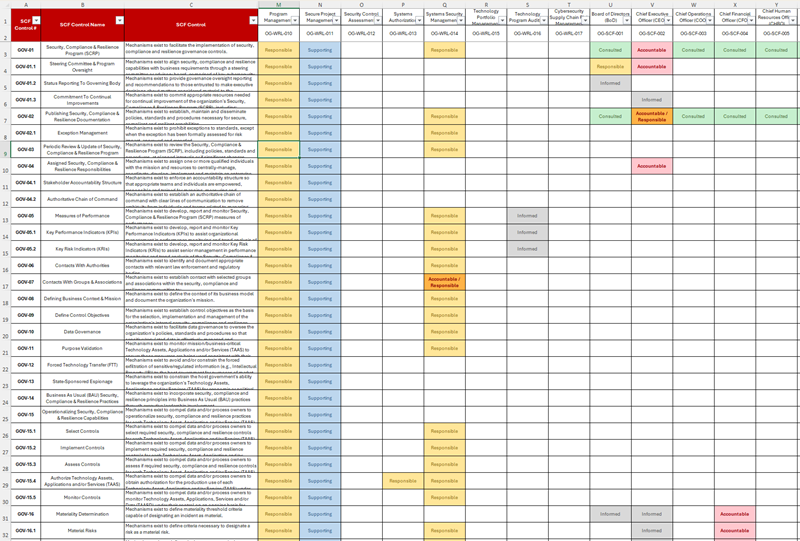
The SCF RASCI is based on the NIST NICE Cybersecurity Workforce Framework, but is tailored for private industry with roles that would be commonly found in Fortune 1000 enterprises that are missing from the NIST framework. The premise is the SCF RASCI is being provided as a generic RASCI perspective that is meant to serve as a starting point for an organization to customize for their specific role structure and naming.
View Product Examples
If you would like to view an example of ComplianceForge's SCF-based RASCI matrix, please click on the image below:
|
|
Designed For Defensible Governance
This RASCI was built for organizations that need a serious, scalable and defensible control ownership model. It is especially useful for organizations that are implementing or maintaining programs based on the Secure Controls Framework (SCF), NIST CSF, NIST SP 800-53, NIST SP 800-171, ISO 27001, SOC 2, CMMC, HIPAA, PCI DSS, GDPR, NY DFS 500, DORA, NIS2 or other cybersecurity and privacy obligations.
The matrix reflects the reality that cybersecurity is not owned by one department. It is an enterprise risk management function that requires participation from leadership, business operations and technical teams.
Where appropriate, the RASCI identifies ownership and involvement across roles such as:
- Board of Directors (BoD)
- Chief Executive Officer (CEO)
- Chief Operations Officer (COO)
- Chief Information Security Officer (CISO)
- Chief Information Officer (CIO)
- Chief Technology Officer (CTO)
- Chief Risk Officer (CRO)
- Chief Financial Officer (CFO)
- Chief Human Resources Officer (CHRO)
- Chief Audit Executive (CAE)
- Chief Legal Officer (CLO) / General Counsel / Legal
- Chief Privacy Officer (CPO)
- Procurement / Vendor Management
- Line of Business (LoB) Executives
- System Owners
- Application Owners
- Data Owners
- Asset Owners
- Security Operations
- IT Operations
- Compliance
- Risk Management
- Internal Audit
- Business Continuity / Resilience
- Third-Party Risk Management (TPRM) / Supply Chain Risk Management (SCRM)